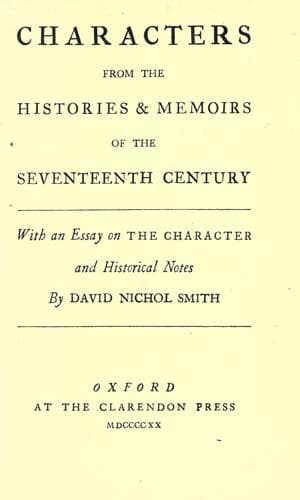
Characters from the Histories & Memoirs of the Seventeenth Century
History
Characters from the Histories & Memoirs of the Seventeenth Century
Great Britain -- Biography; Great Britain -- History -- Stuarts, 1603-1714
Continental historians provided the incentive of rivalry. They too
were the pupils of the Ancients, and taught nothing that might not be
learned equally well or better from their masters, but they invited
the question why England should be behind Italy, France, or the Low
Countries in worthy records of its achievements. In their own century,
Thuanus, Davila, Bentivoglio, Strada, and Grotius set the standard for
modern historical composition. Jacques Auguste de Thou, or Thuanus,
wrote in Latin a history of his own time in 138 books. He intended to
complete it in 143 books with the assassination of Henri IV in 1610,
but his labours were interrupted by his death in 1617. The collected
edition of his monumental work was issued in 1620 under the title
_Iacobi Augusti Thuani Historiarum sui temporis ab anno 1543 usque
ad annum 1607 Libri CXXXVIII_. Enrico Caterino Davila dealt with the
affairs of France from Francis II to Henri IV in his _Historia
delle guerre civili di Francia_, published in 1630. Cardinal Guido
Bentivoglio described the troubles in the Low Countries in his _Della
Guerra di Fiandra_, published from 1632 to 1639. Famianus Strada
wrote on the same subject in Latin; the first part of his _De Bella
Belgico_, which was meant to cover the period from 1555 to 1590 but
was not completed, appeared in 1632, and the second in 1647. Hugo
Grotius, the great Dutch scholar, had long been engaged on his
_Annales et Historiæ de Rebus Belgicis_ when he died in 1640; it was
brought out by his sons in 1657, and contained five books of Annals
from 1566 to 1588, and eighteen books of Histories to 1609. These
five historians were well known in England, and were studied for their
method as well as their matter. Burnet took Thuanus as his model. 'I
have made him ', he says, 'my pattern in writing.'[5] The others are
discussed by Clarendon in a long passage of his essay 'On an Active
and on a Contemplative Life'.[6] He there develops the view, not
without reference to his own history, that 'there was never yet a good
History written but by men conversant in business, and of the best
and most liberal education'; and he illustrates it by comparing the
histories of his four contemporaries:
Public-domain text, read in full here on John Shaqi.
Reviews
Reviews
No reviews yet
Be the first to share your thoughts on this work.
Join the Discussion
Join the discussion
Sign in to leave a comment or review.
Sign InorCreate an account