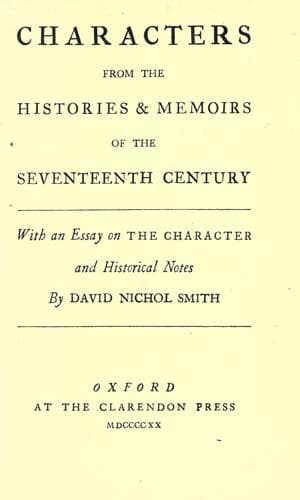
Characters from the Histories & Memoirs of the Seventeenth Century
History
Characters from the Histories & Memoirs of the Seventeenth Century
Great Britain -- Biography; Great Britain -- History -- Stuarts, 1603-1714
France was the home of the _mémoire_, the personal record in which
the individual portrays himself as the centre of his world, and
describes events and persons in the light of his own experience. It
was established as a characteristic form of French literature in the
sixteenth century,[8] and it reached its full vigour and variety
in the century of Sully, Rohan, Richelieu, Tallemant des Réaux,
Bassompierre, Madame de Motteville, Mlle de Montpensier, La
Rochefoucauld, Villars, Cardinal de Retz, Bussy-Rabutin--to name but
a few. This was the age of the _mémoire_, always interesting, often
admirably written; and, as might be expected, sometimes exhibiting the
art of portraiture at perfection. The English memoir is comparatively
late. The word, in the sense of a narrative of personal recollections,
was borrowed at the Restoration. The thing itself, under other names,
is older. It is a branch of history that flourishes in stirring
and difficult times when men believe themselves to have special
information about hidden forces that directed the main current of
events, and we date it in this country from the period of the Civil
Wars. It is significant that when Shaftesbury in his old age composed
his short and fragmentary autobiography he began by saying, 'I in this
follow the French fashion, and write my own memoirs.' Even Swift, when
publishing Temple's _Memoirs_, said that ''tis to the French (if I
mistake not) we chiefly owe that manner of writing; and Sir William
Temple is not only the first, but I think the only Englishman (at
least of any consequence) who ever attempted it.' Few English memoirs
were then in print, whereas French memoirs were to be numbered by
dozens. But the French fashion is not to be regarded as an importation
into English literature, supplying what had hitherto been lacking. At
most it stimulated what already existed.
Public-domain text, read in full here on John Shaqi.
Reviews
Reviews
No reviews yet
Be the first to share your thoughts on this work.
Join the Discussion
Join the discussion
Sign in to leave a comment or review.
Sign InorCreate an account