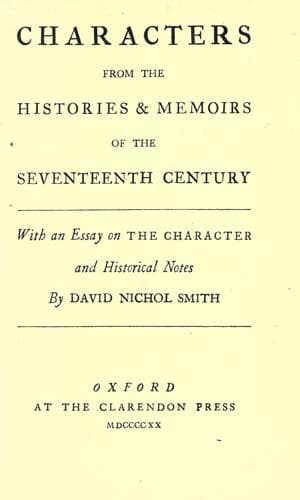
Characters from the Histories & Memoirs of the Seventeenth Century
History
Characters from the Histories & Memoirs of the Seventeenth Century
Great Britain -- Biography; Great Britain -- History -- Stuarts, 1603-1714
Two of these are by so much preferable before the other Two,
that the first may worthily stand by the Sides of the best
of the Ancients, whilst both the others must be placed under
them; and a Man, without knowing more of them, may by reading
their Books find the Difference between their Extractions,
their Educations, their Conversations, and their Judgment. The
first Two are _Henry D'Avila_ and Cardinal _Bentivoglio_, both
_Italians_ of illustrious Birth; ... they often set forth and
describe the same Actions with very pleasant and delightful
Variety; and commonly the greatest Persons they have occasion
to mention were very well known to them both, which makes
their Characters always very lively. Both their Histories are
excellent, and will instruct the ablest and wisest Men how to
write, and terrify them from writing. The other Two were _Hugo
Grotius_ and _Famianus Strada_, who both wrote in _Latin_
upon the same Argument, and of the same Time, of the Wars of
_Flanders_, and of the _Low-Countries_.
He proceeds to show that Grotius, with all his learning and abilities,
and with all his careful revisions, had not been able to give his
narrative enough life and spirit; it was deficient in 'a lively
Representation of Persons and Actions, which makes the Reader present
at all they say or do'. The whole passage, which is too long to
be quoted in full, is not more valuable as a criticism than as an
indication of his own aims, and of his equipment to realize them. Some
years earlier, when he was still thinking 'with much agony' about the
method he was to employ in his own history, he had cited the methods
of Davila, 'who', he added, 'I think hath written as ours should be
written.'[7]
One of Clarendon's tests of a good history, it will be noted, is
the 'lively representation of persons'; the better writers are
distinguished by making 'their characters always very lively'. In
his own hands, and in Burnet's, the character assumes even greater
importance than the continental historians had given it. At every
opportunity Clarendon leaves off his narrative of events to describe
the actors in the great drama, and Burnet introduces his main subject
with what is in effect an account of his _dramatis personæ_. They
excel in the range and variety of their characters. But they had
studied the continental historians, and the encouragement of example
must not be forgotten.
* * * * *
The debt to French literature can easily be overstated. No French
influence is discoverable in the origin and rise of the English
character, nor in its form or manner; but its later development may
have been hastened by French example, especially during the third
quarter of the seventeenth century.
Public-domain text, read in full here on John Shaqi.
Reviews
Reviews
No reviews yet
Be the first to share your thoughts on this work.
Join the Discussion
Join the discussion
Sign in to leave a comment or review.
Sign InorCreate an account