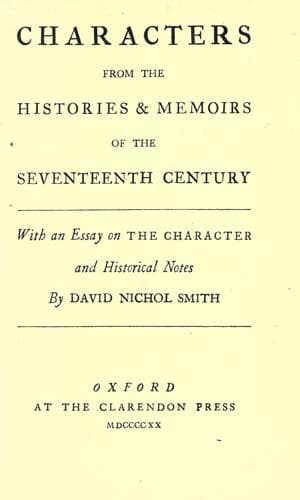
Characters from the Histories & Memoirs of the Seventeenth Century
History
Characters from the Histories & Memoirs of the Seventeenth Century
Great Britain -- Biography; Great Britain -- History -- Stuarts, 1603-1714
published his _Description de I'isle de la Portraiture et de la ville
des Portraits_; and Boileau wrote his _Héros de Roman_.
The effects of all this in England are certainly not obvious. It is
quite a tenable view that the English characters would have been
no less numerous, nor in any way different in quality, had every
Englishman been ignorant of French. But the _mémoires_ and romances
were well known, and it was after 1660 that the art of the character
attained its fullest excellence. The literary career of Clarendon
poses the question in a simple form. Most of his characters, and the
best as a whole, were written at Montpelier towards the close of
his life. Did he find in French literature an incentive to indulge
and perfect his natural bent? Yet there can be no conclusive answer
to those who find a sufficient explanation in the leisure of these
unhappy years, and in the solace that comes to chiefs out of war
and statesmen out of place in ruminating on their experiences and
impressions.
* * * * *
Something may have been learned also from the other kind of character
that is found at its best in modern literature in the seventeenth
century, the character derived from Theophrastus, and depicting not
the individual but the type. In France, the one kind led on to the
other. The romances of Scudéry prepared the way for the _Caractères ou
les Moeurs de ce Siècle_ of La Bruyère. When the fashionable portrait
of particular persons fell out of favour, there arose in its place the
description of dispositions and temperaments; and in the hands of La
Bruyère 'the manners of the century' were the habits and varieties
of human nature. In England the two kinds existed side by side. They
correspond to the two methods of the drama. Begin with the individual,
but draw him in such a way that we recognize in him our own or others'
qualities; or begin with the qualities shared by classes of people,
embody these in a person who stands for the greatest common measure of
the class, and finally--and only then--let him take on his distinctive
traits: these are methods which are not confined to the drama, and
at all stages of our literature have lived in helpful rivalry. Long
before France had her La Bruyère, England had her Hall, Overbury, and
Earle.[15] The Theophrastan character was at its best in this country
at the beginning of the seventeenth century when the historical
character was still in its early stages; and it was declining when
the historical character had attained its full excellence. They cannot
always be clearly distinguished, and they are sometimes purposely
blended, as in Butler's character of 'A Duke of Bucks,' where
the satire on a man of pronounced individuality is heightened by
describing his eccentricities as if they belonged to a recognized
class.
Public-domain text, read in full here on John Shaqi.
Reviews
Reviews
No reviews yet
Be the first to share your thoughts on this work.
Join the Discussion
Join the discussion
Sign in to leave a comment or review.
Sign InorCreate an account