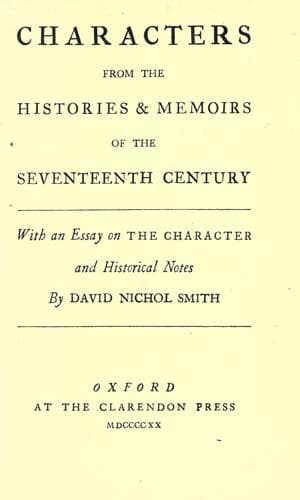
Characters from the Histories & Memoirs of the Seventeenth Century
History
Characters from the Histories & Memoirs of the Seventeenth Century
Great Britain -- Biography; Great Britain -- History -- Stuarts, 1603-1714
The great lesson that the Theophrastan type of character could teach
was the value of balance and unity. A haphazard statement of
features and habits and peculiarities might suffice for a sketch,
but perspective and harmony were necessary to a finished portrait.
It taught that the surest method in depicting character was first
to conceive the character as a whole, and then to introduce detail
incidentally and in proper subordination. But the same lesson could
have been learned elsewhere. It might have been learned from the
English drama.
[Footnote 1: North's Plutarch went into five editions between 1579
and 1631; Thucydides was translated by Hobbes in 1629, and Polybius
by Edward Grimeston in 1633; Xenophon's _Anabasis_ was translated
by John Bingham in 1623, and the _Cyropædia_ by Philemon Holland in
1632; Arthur Golding's version of Cæsar's _Gallic War_ was several
times reprinted between 1565 and 1609; Philemon Holland, the
translator-general of the age, as Fuller called him, brought out
his Livy in 1600, and his Suetonius in 1606; Sallust was translated
by Thomas Heywood in 1608, and by William Crosse in 1629; Velleius
Paterculus was 'rendred English by Sir Robert Le Grys' in 1632; and by
1640 there had been six editions of Sir Henry Savile's _Histories_ and
_Agricola_ of Tacitus, first published in 1591, and five editions of
Richard Grenewey's _Annals_ and _Germany_, first published in 1598.
See H.R. Palmer's _English Editions and Translations of Greek and
Latin Classics printed before 1641_, Bibliographical Society, 1911.]
[Footnote 2: 'Thucydides ... in whom (I beleeve with many others) the
Faculty of writing History is at the Highest.' Thucydides, 1629, 'To
the Readers.']
[Footnote 3: Philemon Holland's Livy, 1600, 'Dedication to
Elizabeth.']
[Footnote 4: Sir Henry Savile's Tacitus, 1591, 'A.B. To the Reader.']
[Footnote 5: _Supplement to Burnet's History_, ed. H.C. Foxcroft, p.
451.]
[Footnote 6: In 'Reflections upon Several Christian Duties, Divine and
Moral, by Way of Essays', printed in _A Collection of several Tracts
of Edward Earl of Clarendon_, 1727, pp. 80-1.]
[Footnote 7: Letter to the Earl of Bristol, February 1, 1646
(_State Papers_, vol. ii, p. 334). Davila was very well known in
England--better, it would appear, than the other three--and was
credited with being more than a mere literary model. Clarendon says
that from his account of the civil wars of France 'no question our
Gamesters learned much of their play'. Sir Philip Warwick, after
remarking that Hampden was well read in history, tells us that the
first time he ever saw Davila's book it was lent to him 'under the
title of Mr. Hambden's _Vade Mecum_' (_Mémoires_, 1701, p. 240).
A translation was published by the authority of the Parliament in
1647-8. Translations of Strada, Bentivoglio, and Grotius followed in
1650, 1654, and 1665. Only parts of Thuanus were translated. The size
of his history was against a complete version.]
Public-domain text, read in full here on John Shaqi.
Reviews
Reviews
No reviews yet
Be the first to share your thoughts on this work.
Join the Discussion
Join the discussion
Sign in to leave a comment or review.
Sign InorCreate an account