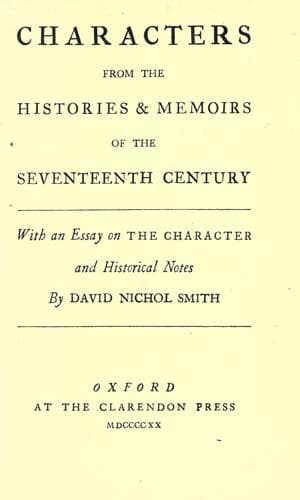
Characters from the Histories & Memoirs of the Seventeenth Century
History
Characters from the Histories & Memoirs of the Seventeenth Century
Great Britain -- Biography; Great Britain -- History -- Stuarts, 1603-1714
From this, as from other passages in his letters, Clarendon's
first intentions are clear. The _History_ was to be a repository of
authentic information on 'this most lovely Rebellion', constructed
with the specifically didactic purpose of showing the King and his
advisers what lessons were to be learned from their errors; they would
be 'the wiser for knowing the most secret truths'. At first he looked
on his work as containing the materials of a 'perfect story', but as
he proceeded his ambitions grew. He had begun to introduce characters;
and when in the spring of 1647 he was about to write his first
character of Lord Falkland, he had come to the view that 'the
preservation of the fame and merit of persons, and deriving the same
to posterity, is no less the business of history than the truth of
things'.[6] He gave much thought to the character of Falkland, 'whom
the next age shall be taught', he was determined, 'to value more than
the present did.'[7] Concurrently with the introduction of characters
he paid more attention to the literary, as distinct from the
didactic, merits of his work. We find him comparing himself with other
historians, and considering what Livy and Tacitus would have done
in like circumstances. By the spring of 1648 he had brought down his
narrative to the opening of the campaign of 1644. Earlier in the
year he had been commanded by the King to be ready to rejoin Prince
Charles, and shortly afterwards he received definite instructions from
the Queen to attend on her and the Prince at Paris. He left Jersey
in June, and with his re-entry into active politics his _History_ was
abruptly ended. The seven years of retirement which he had anticipated
were cut down by the outbreak of the Second Civil War to two; and
within a year the King for whose benefit he had begun this _History_
was led to the scaffold. Not for twenty years was Clarendon again to
have the leisure to be an historian. When in 1668 he once more took
up his pen, it was not a continuation of the first work, but an
entirely new work, that came in steady flow from the abundance of his
knowledge.
Public-domain text, read in full here on John Shaqi.
Reviews
Reviews
No reviews yet
Be the first to share your thoughts on this work.
Join the Discussion
Join the discussion
Sign in to leave a comment or review.
Sign InorCreate an account