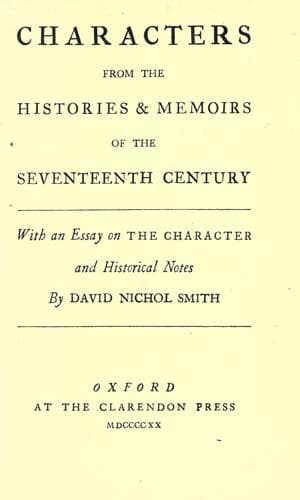
Characters from the Histories & Memoirs of the Seventeenth Century — John Shaqi
Characters from the Histories & Memoirs of the Seventeenth Century
History
Characters from the Histories & Memoirs of the Seventeenth Century
Great Britain -- Biography; Great Britain -- History -- Stuarts, 1603-1714
Clarendon returned to England as Lord Chancellor in 1660, and for
seven years enjoyed the power which he had earned by ceaseless
devotion to his two royal masters. The ill success of the war with the
Dutch, jealousy of his place and influence, the spiteful opposition
of the King's chief mistress, and the King's own resentment at an
attitude that showed too little deference and imprudently suggested
the old relations of tutor and pupil, all combined to bring about his
fall. He fled from England on November 30, 1667, and was never to set
foot in England again. Broken in health and spirit, he sought in vain
for many months a resting-place in France, and not till July 1668 did
he find a new home at Montpelier. Here his health improved, and here
he remained till June 1671. These were busy years of writing, and
by far the greater portion of his published work, if his letters
and state papers be excluded, belongs to this time. First of all he
answered the charge of high treason brought against him by the House
of Commons in _A Discourse, by Way of Vindication of my self_, begun
on July 24, 1668; he wrote most of his _Reflections upon Several
Christian Duties, Divine and Moral_, a collection of twenty-five
essays, some of considerable length, on subjects largely suggested
by his own circumstances; and he completed between December 1668 and
February 1671 his _Contemplations and Reflections upon the Psalms of
David_, an elaborate exposition extending to well over four hundred
folio pages of print, which he had begun at Jersey in 1647. But his
great work at this time was his _Life_, begun on July 23, 1668,
and brought down to 1660 by August 1, 1670. It is by far the most
elaborate autobiography that had yet been attempted in English. The
manuscript consists of over six hundred pages, and each page contains
on an average about a thousand words. He wrote with perfect freedom,
for this work, unlike the earlier _History_, was not intended for the
eyes of the King, and the didactic days were over. He wrote too with
remarkable ease. The very appearance of the manuscript, where page
follows page with hardly an erasure, and the 'fine hand' becomes finer
and finer, conveys even a sense of relief and pleasure. His pen seems
to move of itself and the long and elaborate sentences to evolve of
their own free will. The story of his life became a loose framework
into which he could fit all that he wished to tell of his own times;
and the more he told, his vindication would be the more complete.
'Even unawares', he admitted, 'many things are inserted not so
immediately applicable to his own person, which possibly may
hereafter, in some other method, be communicated to the world.'[8] He
welcomed the opportunity to tell all that he knew. There was no reason
for reticence. He wrote of men as of things frankly as he knew them.
More than a history of the Rebellion, his _Life_ is also a picture of
the society in which he had moved. It is the work which contains most
Public-domain text, read in full here on John Shaqi.
Reviews
Reviews
No reviews yet
Be the first to share your thoughts on this work.
Join the Discussion
Join the discussion
Sign in to leave a comment or review.
Sign InorCreate an account