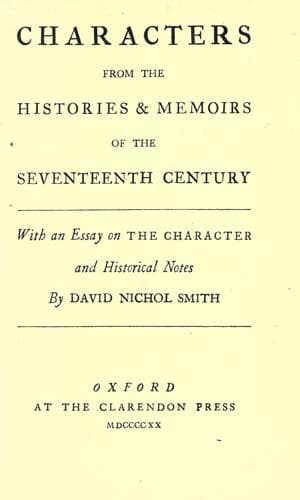
Characters from the Histories & Memoirs of the Seventeenth Century
History
Characters from the Histories & Memoirs of the Seventeenth Century
Great Britain -- Biography; Great Britain -- History -- Stuarts, 1603-1714
Page 121, l. 2. _sharpe reprehension_. 'He was committed to the Fleet
in June 1634, but released in July, for striking Mr. Crofts in Spring
Garden, within the precincts of the Court. _Cal. Dom. State. Papers_,
1634-5 (1864), pp. 81, 129'--Macray, vol. i, p. 461.
Shaftesbury gives a brief sketch of him at this time in his
fragmentary autobiography: 'The Earl of Bristoll was retired from all
business and lived privately to himself; but his son the Lord Digby,
a very handsome young man of great courage and learning and of a quick
wit, began to show himself to the world and gave great expectations
of himself, he being justly admired by all, and only gave himself
disadvantage with a pedantic stiffness and affectation he had
contracted.'
l. 19. As Baron Digby, during the lifetime of his father; June 9,
1641.
Page 123, l. 5. _a very unhappy councell_, the impeachment and
attempted 'Arrest of the Five Members', January 3 and 4, 1642. Compare
Clarendon, vol. i, p. 485: 'And all this was done without the least
communication with any body but the Lord Digby, who advised it.'
31.
Clarendon, MS. Life, p. 389, and MS. History, p. 25 (or 597);
_History_, Bk. XI, ed. 1704, vol. iii, pp. 210-11; ed. Macray, vol.
iv, pp. 510-11.
This admirable character was not all written at the same time. The
first sentence is from Clarendon's Life, and the remainder from the
History, where the date, '21 Nov. 1671', is appended. 123, l. 15.
_Crumwells owne character_,--in the debate in Parliament on carrying
out the sentence of death, March 8, 1649. Clarendon had briefly
described Cromwell's speech: 'Cromwell, who had known him very well,
spake so much good of him, and professed to have so much kindness
and respect for him, that all men thought he was now safe, when he
concluded, that his affection to the public so much weighed down his
private friendship, that he could not but tell them, that the question
was now, whether they would preserve the most bitter and the most
implacable enemy they had' (vol. iv, p. 506).
l. 22. He married in November 1626, Elizabeth, daughter of Sir Charles
Morrison, of Cassiobury, Hertfordshire, and granddaughter of the first
Viscount Campden. Their daughter Theodosia was the wife of the second
Earl of Clarendon.
Page 124, l. 13. _an indignity_, probably a reference to Lord Hopton's
command of the army in the west; see vol. iv, p. 131.
32.
Clarendon, MS. Life, p. 273; _History_, Bk. VIII, ed. 1703, vol. ii,
pp. 427-8; ed. Macray, vol. iii, pp. 443-5.
The four generals in this group are described on various occasions in
the _History_. In this passage Clarendon sums up shortly what he says
elsewhere, and presents a parallel somewhat in the manner of Plutarch.
Public-domain text, read in full here on John Shaqi.
Reviews
Reviews
No reviews yet
Be the first to share your thoughts on this work.
Elsewhere in the archive
Join the Discussion
Join the discussion
Sign in to leave a comment or review.
Sign InorCreate an account