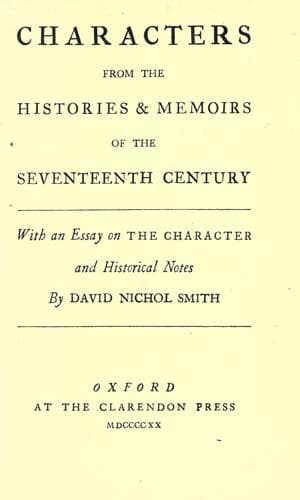
Characters from the Histories & Memoirs of the Seventeenth Century
History
Characters from the Histories & Memoirs of the Seventeenth Century
Great Britain -- Biography; Great Britain -- History -- Stuarts, 1603-1714
Page 125, l. 23. Clarendon has a great passage in Book VII (vol. iii,
pp. 224-6) on the value of Councils, even when the experience and
wisdom of the councillors individually may not promise the right
decisions. The passage is suggested by, and immediately follows, a
short character of Prince Rupert.
Page 126, ll. 15, 16. Clarendon refers to the retreat of the
Parliamentary Army at Lostwithiel, on August 31, 1644, when Essex
embarked the foot at Fowey and escaped by sea, and Sir William Balfour
broke away with the horse. In describing it, Clarendon says that 'the
notice and orders came to Goring when he was in one of his jovial
exercises; which he received with mirth, and slighting those who sent
them, as men who took alarms too warmly; and he continued his delights
till all the enemy's horse were passed through his quarters, nor did
then pursue them in any time' (vol. iii, p. 403; cf. p. 391). But
Goring's horse was not so posted as to be able to check Balfour's.
See the article on Goring by C.H. Firth in the _Dictionary of National
Biography_ and S.R. Gardiner's _Civil War_, 1893, vol. ii, pp. 13-17.
Clarendon was misinformed; yet this error in detail does not impair
the truth of the portrait.
33.
Clarendon, MS. History, pp. 447-8; _History_, Bk. VII, ed. 1704, vol.
ii, pp. 204-6; ed. Macray, vol. iii, pp. 61-4.
The studied detachment that Clarendon tried to cultivate when writing
about his political enemies is nowhere shown better than in the
character of Hampden. 'I am careful to do justice', he claimed, 'to
every man who hath fallen in the quarrel, on which side soever, as
you will find by what I have said of Mr. Hambden himself' (see No.
21, note). The absence of all enthusiasm makes the description of
Hampden's merits the more telling. But there is a tail with a sting in
it.
The last sentence, it must be admitted, is not of a piece with
the rest of the character. There was some excuse for doubting its
authenticity. But doubts gave place to definite statements that it
had been interpolated by the Oxford editors when seeing the
_History_ through the press. Edmund Smith, the author of _Phædra and
Hippolytus_, started the story that while he was resident in Christ
Church he was 'employ'd to interpolate and alter the Original', and
specially mentioned this sentence as having been 'foisted in'; and
the story was given a prominent place by Oldmixon in his _History of
England, during the Reigns of the Royal House of Stuart_ (see _Letters
of Thomas Burnat to George Duckett_, ed. Nichol Smith, 1914, p. xx).
A controversy ensued, the final contribution to which is John Burton's
_Genuineness of L'd Clarendon's History Vindicated_, 1744. Once the
original manuscript was accessible, all doubt was removed. Every word
of the sentence is there to be found in Clarendon's hand. But it is
written along the margin, to take the place of a deleted sentence, and
is evidently later than the rest of the character. This accounts for
the difference in tone.
Public-domain text, read in full here on John Shaqi.
Reviews
Reviews
No reviews yet
Be the first to share your thoughts on this work.
Elsewhere in the archive
Join the Discussion
Join the discussion
Sign in to leave a comment or review.
Sign InorCreate an account