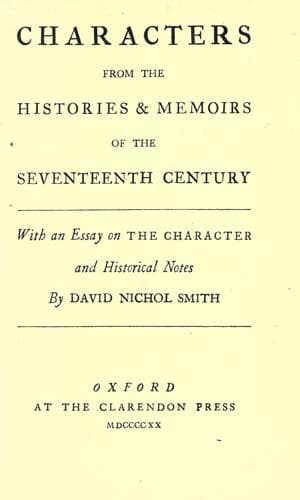
Characters from the Histories & Memoirs of the Seventeenth Century
History
Characters from the Histories & Memoirs of the Seventeenth Century
Great Britain -- Biography; Great Britain -- History -- Stuarts, 1603-1714
Page 129, ll. 22 ff. Compare Warwick, _Mémoires_, p. 240: 'He was of
a concise and significant language, and the mildest, yet subtillest,
speaker of any man in the House; and had a dexterity, when a question
was going to be put, which agreed not with his sense, to draw it over
to it, by adding some equivocall or sly word, which would enervate the
meaning of it, as first put.'
At the beginning of this short character of Hampden, Warwick says that
'his blood in its temper was acrimonious, as the scurfe commonly on
his face shewed'.
Page 131, l. 4. _this that was at Oxforde_, i.e. the overture,
February and March 1643: Clarendon, vol. ii, pp. 497 ff.
ll. 24-6. _Erat illi_, &c. Cicero, _Orat. in Catilinam_ iii. 7.
'Cinna' should be 'Catiline'.
34.
Clarendon, MS. History, pp. 525-7; _History_, Bk. VII, ed. 1703, vol.
ii, pp. 353-5; ed. Macray, vol. iii, pp. 321-4.
The character of Pym does not show the same detachment as the
character of Hampden. Clarendon has not rejected unauthenticated
Royalist rumour.
Page 132, ll. 7-9. This rumour occasioned the publication of an
official narrative of his disease and death, 'attested under the Hands
of his Physicians, Chyrurgions, and Apothecary', from which it appears
that he died of an intestinal abscess. See John Forster's _John Pym_
('Lives of Eminent British Statesmen', vol. iii), pp. 409-11.
l. 19. He was member for Tavistock from 1624.
Page 133, l. 26. Oliver St. John (1603-42), Solicitor-General,
mortally wounded at Edgehill.
ll. 29, 30. Cf. p. 129, ll. 15-18.
Page 134, l. 3. Francis Russell (1593-1641), fourth Earl of Bedford.
'This lord was the greatest person of interest in all the popular
party, being of the best estate and best understanding of the whole
pack, and therefore most like to govern the rest; he was besides of
great civility, and of much more good-nature than any of the others.
And therefore the King, resolving to do his business with that party
by him, resolved to make him Lord High Treasurer of England, in the
place of the Bishop of London, who was as willing to lay down the
office as any body was to take it up; and, to gratify him the more, at
his desire intended to make Mr. Pimm Chancellor of the Exchequer, as
he had done Mr. St. John his Solicitor-General' (Clarendon, vol. i,
p. 333). The plan was frustrated by Bedford's death in 1641. The
Chancellorship of the Exchequer was bestowed on Culpeper (_id._, p.
457).
ll. 27 ff. The authority for this story is the _Mercurius Academicus_
for February 3, 1645-6 (pp. 74-5), a journal of the Court party
published at Oxford (hence the title), and the successor of the
_Mercurius Aulicus_. The Irishman is there reported to have made this
confession on the scaffold.
Page 135, ll. 25-8. _The last Summer_, i.e. before Pym's death, 1643.
See Clarendon, vol. iii, pp. 116, 135, 141.
Page 136, ll. 7-10. He died on December 8, 1643, and was buried on
December 13 in Westminster Abbey, whence his body was ejected at the
Restoration.
35.
Public-domain text, read in full here on John Shaqi.
Reviews
Reviews
No reviews yet
Be the first to share your thoughts on this work.
Elsewhere in the archive
Join the Discussion
Join the discussion
Sign in to leave a comment or review.
Sign InorCreate an account