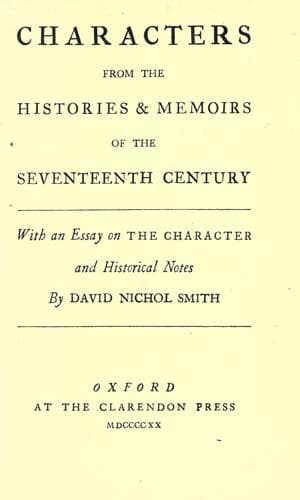
Characters from the Histories & Memoirs of the Seventeenth Century
History
Characters from the Histories & Memoirs of the Seventeenth Century
Great Britain -- Biography; Great Britain -- History -- Stuarts, 1603-1714
Clarendon, MS. History, Bk. X, p. 24 (or 570); _History_, ed. 1704,
vol. iii, pp. 84-5; ed. Macray, vol. iv, pp. 305-7.
The two characters of Cromwell by Clarendon were written about the
same time. Though the first is from the manuscript of the History,
it belongs to a section that was added in 1671, when the matter in
the original History was combined with the matter in the Life. It
describes Cromwell as Clarendon remembered him before he had risen
to his full power. He was then in Clarendon's eyes preeminently a
dissembler--'the greatest dissembler living'. The other character
views him in the light of his complete achievement. It represents
him, with all his wickedness, as a man of 'great parts of courage and
industry and judgement'. He is a 'bad man', but a 'brave, bad man',
to whose success, remarkable talents, and even some virtues, must have
contributed. The recognition of his greatness was unwilling; it was
all the more sincere.
'Crumwell' is Clarendon's regular spelling.
Page 136, l. 22. Hampden's mother, Elizabeth Cromwell, was the sister
of Cromwell's father.
Page 138, l. 18. _the Modell_, i.e. the New Model Army, raised in the
Spring of 1645. See C.H. Firth's _Cromwell's Army_, 1902, ch. iii.
l. 21. _chaunged a Generall_, the Earl of Essex. See No. 40.
36.
Clarendon, MS. Life, pp. 549-50; _History_, Bk. XV, ed. 1704, vol.
iii, pp. 505-6, 509; ed. Macray, vol. vi, pp. 91-2, 97.
Page 139, ll. 3, 4. _quos vituperare_, Cicero, _Pro Fonteio_, xvii.
39 'Is igitur vir, quem ne inimicus quidem satis in appellando
significare poterat, nisi ante laudasset.'
ll. 19, 20. _Ausum eum_, Velleius Paterculus, ii. 24.
Page 140, ll. 9-12. Machiavelli, _The Prince_, ch. vii.
ll. 17-22. Editorial taste in 1704 transformed this sentence thus:
'In a word, as he was guilty of many Crimes against which Damnation
is denounced, and for which Hell-fire is prepared, so he had some good
Qualities which have caused the Memory of some Men in all Ages to be
celebrated; and he will be look'd upon by Posterity as a brave wicked
Man.'
37.
Mémoires Of the reigne of King Charles I, 1701, pp. 247-8.
Page 141, l. 17. _a servant of Mr. Prynn's_, John Lilburne (1614-57).
But it is doubtful if he was Prynne's servant; see the article in the
_Dictionary of National Biography_. Lilburne's petition was presented
by Cromwell on November 9, 1640, and referred to a Committee; and
on May 4, 1641, the House resolved 'That the Sentence of the
Star-Chamber, given against John Lilborne, is illegal, and against the
Liberty of the Subject; and also, bloody, wicked, cruel, barbarous,
and tyrannical' (_Journals of the House of Commons_, vol. ii, pp. 24,
134).
ll. 29, 30. Warwick was imprisoned on suspicion of plotting against
the Protector's Government in 1655.
38.
A Collection of the State Papers of John Thurloe, Esq.; Edited by
Thomas Birch, 1742, vol. i, p. 766.
Public-domain text, read in full here on John Shaqi.
Reviews
Reviews
No reviews yet
Be the first to share your thoughts on this work.
Elsewhere in the archive
Join the Discussion
Join the discussion
Sign in to leave a comment or review.
Sign InorCreate an account