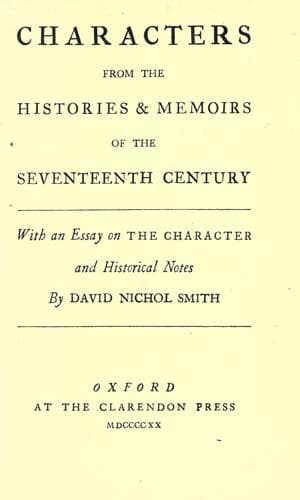
Characters from the Histories & Memoirs of the Seventeenth Century
History
Characters from the Histories & Memoirs of the Seventeenth Century
Great Britain -- Biography; Great Britain -- History -- Stuarts, 1603-1714
This passage is from a letter written to 'John Winthrop, esq; governor
of the colony of Connecticut in New England', and dated 'Westminster,
March 24, 1659'.
Maidston was Cromwell's servant.
39.
Reliquiæ Baxterianæ: or, Mr. Richard Baxter's Narrative of The most
Memorable Passages of his Life and Times. Faithfully Publish'd from
his own Original Manuscript, By Matthew Sylvester. London: MDCXCVI.
(Lib. I, Part I, pp. 98-100.)
The interest of this character lies largely in its Presbyterian point
of view. It is a carefully balanced estimate by one who had been a
chaplain in the Parliamentary army, but opposed Cromwell when, after
the fall of Presbyterianism, he assumed the supreme power.
Page 144, ll. 19-24. See the article by C.H. Firth on 'The Raising of
the Ironsides' in the Transactions of the Royal Historical Society,
1899, vol. xiii, and its sequel, 'The Later History of the Ironsides',
1901, vol. xv; and the articles on John Desborough (who married
Cromwell's sister) and James Berry in the _Dictionary of National
Biography_. 'Who Captain Ayres was it is difficult to say ... He left
the regiment about June 1644, and his troop was given to James Berry
... the captain-lieutenant of Cromwell's own troop'. (R.H.S. Trans.,
vol. xiii, pp. 29, 30). Berry subsequently became one of Cromwell's
major-generals. His character is briefly sketched by Baxter, who
calls him 'my old Bosom Friend', _Reliquiæ_, 1696, p. 57. For Captain
William Evanson, see R.H.S. Trans., vol. xv, pp. 22-3.
Page 146, l. 12. A passage from Bacon's essay 'Of Faction' (No. 51)
is quoted in the margin in the edition of 1696. 'Fraction' in l. 12 is
probably a misprint for 'Faction'.
Page 148, ll. 7-10. The concluding sentence of the essay 'Of
Simulation and Dissimulation'. Brackets were often used at this time
to mark a quotation.
40.
Reliquiæ Baxterianæ, 1696, Lib. I, Part I, p. 48.
Much the same opinion of Fairfax was held by Sir Philip Warwick and
Clarendon. Warwick says he was 'a man of a military genius, undaunted
courage and presence of mind in the field both in action and danger,
but of a very common understanding in all other affairs, and of a
worse elocution; and so a most fit tool for Mr. Cromwel to work with'
(_Mémoires_, p. 246). Clarendon alludes to him as one 'who had no
eyes, and so would be willinge to be ledd' (p. 138, l. 24). But Milton
saw him in a different light when he addressed to him the sonnet on
his capture of Colchester in August 1648:
_Fairfax_, whose name in armes through Europe rings
Filling each mouth with envy, or with praise,...
Thy firm unshak'n vertue ever brings
Victory home,...
O yet a nobler task awaites thy hand;
For what can Warr, but endless warr still breed,
Till Truth, & Right from Violence be freed,
And Public Faith cleard from the shamefull brand
Of Public Fraud. In vain doth Valour bleed
While Avarice, & Rapine share the land.
Public-domain text, read in full here on John Shaqi.
Reviews
Reviews
No reviews yet
Be the first to share your thoughts on this work.
Elsewhere in the archive
Join the Discussion
Join the discussion
Sign in to leave a comment or review.
Sign InorCreate an account