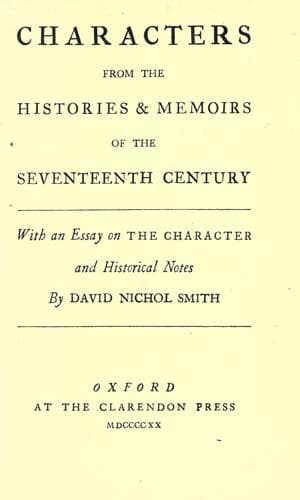
Characters from the Histories & Memoirs of the Seventeenth Century
History
Characters from the Histories & Memoirs of the Seventeenth Century
Great Britain -- Biography; Great Britain -- History -- Stuarts, 1603-1714
We are fortunate in having companion characters of Lauderdale by
Clarendon and Burnet. Their point of view is different. Clarendon
describes the Lauderdale of the Restoration who is climbing to power
and is officially his inferior. Burnet looks back on him at the
height of power and remembers how it was made to be felt. But the two
characters have a strong likeness. Burnet is here seen at his best.
Page 228, ll. 14-17. Compare Roger North's _Lives of the Norths_, ed.
1890, vol. i, p. 231: 'the duke himself, being also learned, having
a choice library, took great pleasure ... in hearing him talk of
languages and criticism'. Compare also Evelyn's _Diary_, August 27,
1678. His library was dispersed by auction--the French, Italian, and
Spanish books on May 14, and the English books on May 27, 1690: copies
of the sale catalogues are in the Bodleian. The catalogue of his
manuscripts, 1692, is printed in the _Bannatyne Miscellany_, vol. ii,
1836, p. 149.
l. 30. As Professor of Theology in the University of Glasgow Burnet
had enjoyed the favour of Lauderdale, and had dedicated to him, in
fulsome terms, _A Vindication of the Church and State of Scotland_.
The break came suddenly, and with no apparent cause, in 1673, when
Burnet was appointed royal chaplain and was winning the ears of the
King. Henceforward Lauderdale continued a 'violent enemy'. Their
relations at this time are described in Clarke and Foxcroft's _Life of
Gilbert Burnet_, 1907, pp. 109 ff., where Burnet's concluding letter
of December 15, 1673, is printed in full.
Page 229, ll. 2-7. Richard Baxter delivered himself to Lauderdale in a
long letter about his lapse from his former professions of piety--'so
fallne from all that can be called serious religion, as that
sensuality and complyance with sin is your ordinary course.' The
letter (undated, but before 1672) is printed in _The Landerdale
Papers_, ed. Osmund Airy, Camden Society, vol. iii, 1885, pp. 235-9.
ll. 8-12. 'The broad and pungent wit, and the brutal _bonhomie_..
probably went as far as anything else in securing Charles's favour.'
Osmund Airy, Burnet's _History_, vol. i, p. 185.
68.
Burnet's History of His Own Time. Vol. i. (pp. 96-7.)
Page 230, l. 14. He was chosen for Tewkesbury in March 1640, but he
did not sit in the Long Parliament.
l. 18, _a town_, Weymouth: see p. 70, l. 21 note. He had been
appointed governor of it in August 1643 after some dispute, but was
shortly afterwards removed (Clarendon, vol. iii, pp. 163-5, 362).
Page 231, l. 2. Shaftesbury writes about the prediction of 'Doctor
Olivian, a German, a very learned physician', in his autobiographical
fragment: see No. 14 note.
ll. 14, 15. Compare Burnet's first sketch of Shaftesbury, ed.
Foxcroft, p. 59: 'he told some that Cromwell offered once to make him
king, but he never offered to impose so gross a thing on me.'
Public-domain text, read in full here on John Shaqi.
Reviews
Reviews
No reviews yet
Be the first to share your thoughts on this work.
Elsewhere in the archive
Join the Discussion
Join the discussion
Sign in to leave a comment or review.
Sign InorCreate an account