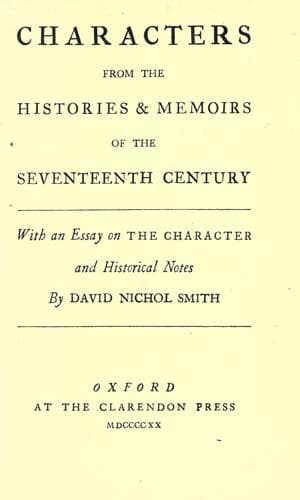
Characters from the Histories & Memoirs of the Seventeenth Century
History
Characters from the Histories & Memoirs of the Seventeenth Century
Great Britain -- Biography; Great Britain -- History -- Stuarts, 1603-1714
ll. 17, 18. See the Newsletter of December 28, 1654, in _The Clarke
Papers_, ed. C.H. Firth, Camden Society, 1899, p. 16: 'a few daies
since when the House was in a Grand Committee of the whole House upon
the Government, Mr. Garland mooved to have my Lord Protectour crowned,
which mocion was seconded by Sir Anthony Ashley Cooper, Mr. Hen.
Cromwell, and others, but waved.'
l. 26. After 'party' Burnet wrote (autograph, fol. 49) 'He had no sort
of virtue: for he was both a leud and corrupt man: and had no regard
either to trueth or Justice.' But he struck out 'no sort ... and had'.
The sentence thus read in the transcript (p. 76) 'He had no regard
either to Truth or Justice'. This in turn was struck out, either by
Burnet himself or by the editor.
The following words are likewise struck out in the transcript, after
'manner' (l. 28): 'and was not out of countenance in owning his
unsteadiness and deceitfullness.'
69.
Absalom and Achitophel. A Poem ... The Second Edition; Augmented and
Revised. London, 1681. (ll. 142-227.)
The first edition was published on November 17, 1681, a few days
before Shaftesbury's trial for high treason. In the second, which
appeared within a month, the character of Shaftesbury was 'augmented'
by twelve lines (p. 233, ll. 17-28).
Shaftesbury had been satirized by Butler in the Third Part of
_Hudibras_, 1678, three years before the crisis in his remarkable
career, and while his schemes still prospered. To Butler he is the
unprincipled turn-coat who thinks only of his own interests:
So Politick, as if one eye
Upon the other were a Spye;...
H'had seen three Governments Run down,
And had a Hand in ev'ry one,
Was for 'em, and against 'em all.
But Barb'rous when they came to fall:...
By giving aim from side, to side,
He never fail'd to save his Tide,
But got the start of ev'ry State,
And at a Change, ne'r came too late....
Our _State-Artificer_ foresaw,
Which way the World began to draw:...
He therefore wisely cast about,
All ways he could, t'_insure his Throat_;
And hither came t'observe, and smoke
What Courses other Riscers took:
And to the utmost do his Best
To Save himself, and Hang the Rest.
(Canto II, ll. 351-420).
Dryden's satire should be compared with Butler's. But a comparison
with the prose character by Burnet, which had no immediate political
purpose, will reveal even better Dryden's mastery in satirical
portraiture. Another verse character is in _The Review_ by Richard
Duke, written shortly after Dryden's poem.
Absalom is Monmouth, David Charles II, Israel England, the Jews the
English, and a Jebusite a Romanist.
Page 232, l. 28. Compare Seneca, _De Tranquillitate Animi_, xvii. 10:
'nullum magnum ingenium sine mixtura dementiæ fuit.'
Page 233, l. 7. The humorous definition of man ascribed to Plato in
Diogenes Laertius, Lib. vi. 40 (Life of Diogenes), [Greek: Platonos
horisamenou, anthropos esti zoon dipoun apteron.]
Public-domain text, read in full here on John Shaqi.
Reviews
Reviews
No reviews yet
Be the first to share your thoughts on this work.
Elsewhere in the archive
Join the Discussion
Join the discussion
Sign in to leave a comment or review.
Sign InorCreate an account