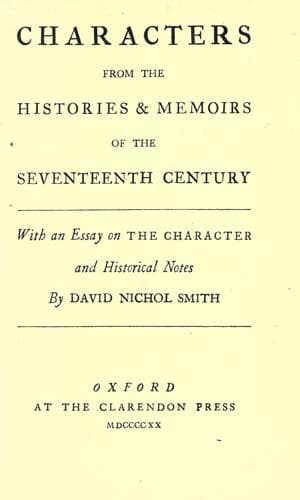
Characters from the Histories & Memoirs of the Seventeenth Century
History
Characters from the Histories & Memoirs of the Seventeenth Century
Great Britain -- Biography; Great Britain -- History -- Stuarts, 1603-1714
The son was a handsomer man than the father, though he did not inherit
his ability. His son, the third earl, was the critic and philosopher
who wrote the _Characteristicks_.
l. 12. _the Triple Bond_, the alliance of England, Holland, and Sweden
against France in 1667, broken by the war with France against Holland
in 1672. But Shaftesbury then knew nothing of the secret Treaty of
Dover, 1670.
l. 16. _Usurp'd_, in ed. 1 'Assum'd'.
l. 25. _Abbethdin_ 'the president of the Jewish judicature', 'the
father of the house of judgement'. Shaftesbury was Lord Chancellor,
1672-3.
Page 234, l. 4. David would have sung his praises instead of writing a
psalm, and so Heaven would have had one psalm the less.
ll. 5, 6. Macaulay pointed out in his essay on Sir William Temple
that these lines are a reminiscence of a couplet under the portrait of
Sultan Mustapha the First in Knolles's _Historie of the Turkes_ (ed.
1638, p. 1370):
Greatnesse, on Goodnesse loues to slide, not stand,
and leaues for Fortunes ice, Vertues firm land.
l. 15. The alleged Popish Plot, invented by Titus Oates, to murder the
king and put the government in the hands of the Jesuits. Shaftesbury
had no share in the invention, but he believed it, and made political
use of it.
Page 235, l. 4. This line reappears in _The Hind and the Panther_,
Part I, l. 211. As W.D. Christie pointed out, it is a reminiscence
of a couplet in _Lachrymæ Musarum_, 1649, the volume to which
Dryden contributed his school-boy verses 'Upon the Death of the Lord
Hastings':
It is decreed, we must be drain'd (I see)
Down to the dregs of a _Democracie_.
This is the opening couplet of the English poem preceding Dryden's,
and signed 'M.N.' i.e. Marchamont Needham (p. 81).
70.
Burnet's History of His Own Time. Vol. i. (p. 100.)
'The portrait of this Duke has been drawn by four masterly hands:
Burnet has hewn it out with his rough chissel; Count Hamilton touched
it with that slight delicacy, that finishes while it seems but to
sketch; Dryden catched the living likeness; Pope compleated the
historical resemblance.'--Horace Walpole, _Royal and Noble Authors_,
ed. 1759, vol. ii, p. 78.
There is also Butler's prose character of 'A Duke of Bucks', first
printed in Thyer's edition of the _Genuine Remains of Butler_, 1759,
vol. ii, pp. 72-5, but written apparently about 1667-9. And there is a
verse character in Duke's _Review_.
Page 235, l. 11. _a great liveliness of wit_. In the first sketch
Burnet wrote 'he has a flame in his wit that is inimitable'. It lives
in _The Rehearsal_. His 'Miscellaneous Works' were collected in two
volumes by Tom Brown, 1704-5.
Page 236, l. 12. Compare Butler: 'one that has studied the whole Body
of Vice.'
l. 14. Sir Henry Percy, created Baron Percy of Alnwick in 1643. He
was then general of the ordinance of the king's army. He joined the
Queen's party in France in 1645.
l. 15. _Hobbs_. For Burnet's view of Hobbes, see p. 246, ll. 21 ff.
71.
Public-domain text, read in full here on John Shaqi.
Reviews
Reviews
No reviews yet
Be the first to share your thoughts on this work.
Elsewhere in the archive
Join the Discussion
Join the discussion
Sign in to leave a comment or review.
Sign InorCreate an account