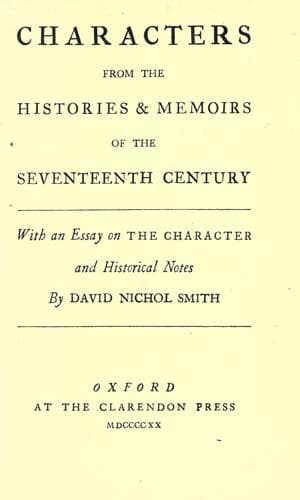
Characters from the Histories & Memoirs of the Seventeenth Century
History
Characters from the Histories & Memoirs of the Seventeenth Century
Great Britain -- Biography; Great Britain -- History -- Stuarts, 1603-1714
Absalom and Achitophel. Second Edition. 1681. (ll. 543-68.)
Dryden is his own best critic: 'The Character of _Zimri_ in my
_Absalom_, is, in my Opinion, worth the whole Poem: 'Tis not bloody,
but 'tis ridiculous enough. And he for whom it was intended, was
too witty to resent it as an injury. If I had rail'd, I might have
suffer'd for it justly: But I manag'd my own Work more happily,
perhaps more dextrously. I avoided the mention of great Crimes
and apply'd my self to the representing of Blind-sides, and little
Extravagancies: To which, the wittier a Man is, he is generally the
more obnoxious. It succeeded as I wish'd.' ('Discourse concerning
Satire' prefixed to Dryden's Juvenal, 1693, p. xlii.)
Burnet's prose character again furnishes the best commentary.
Page 236, ll. 28 ff. Compare Butler: 'He is as inconstant as the Moon,
which he lives under ... His Mind entertains all Things very freely,
that come and go; but, like Guests and Strangers they are not
welcome, if they stay long ... His Ears are perpetually drilled with
a Fiddlestick. He endures Pleasures with less Patience, than other Men
do their Pains.'
72.
Burnet's History of His Own Time. Vol. i. (pp. 267-8.)
This is not one of Burnet's best characters. He did not see the
political wisdom that lay behind the ready wit. Halifax was too subtle
for Burnet's heavy-handed grasp. To recognize the inadequacy of this
short-sighted estimate, it is sufficient to have read the 'Character
of King Charles II' (No. 62).
Burnet suffered from Halifax's wit: 'In the House of Lords,' says the
first Earl of Dartmouth, 'he affected to conclude all his discourses
with a jest, though the subject were never so serious, and if it did
not meet with the applause he expected, would be extremely out of
countenance and silent, till an opportunity offered to retrieve the
approbation he thought he had lost; but was never better pleased than
when he was turning Bishop Burnet and his politics into ridicule'
(Burnet, ed. Airy, vol. i, p. 485).
Dryden understood Halifax, the Jotham of his _Absalom and Achitophel_:
_Jotham_ of piercing Wit and pregnant Thought:
Endew'd by Nature, and by Learning taught
To move Assemblies, who but onely tri'd
The worse awhile, then chose the better side;
Nor chose alone, but turn'd the Balance too;
So much the weight of one brave man can do.
See also Dryden's dedication to Halifax of his _King Arthur_.
73.
The Life of the Right Honourable Francis North, Baron of Guilford,
Lord Keeper of the Great Seal, under King Charles II. and King James
II.... By the Honourable Roger North, Esq; London, MDCCXLII. (pp.
223-6.)
Roger North's lives of his three brothers, Lord Keeper Guilford,
Sir Dudley North, and Dr. John North, Master of Trinity College,
Cambridge, were begun about 1710 but were not published till 1742-4,
eight years after his death. The edition of the 'Lives of the Norths'
by Augustus Jessopp, 3 vols., 1890, contains also his autobiography.
Public-domain text, read in full here on John Shaqi.
Reviews
Reviews
No reviews yet
Be the first to share your thoughts on this work.
Elsewhere in the archive
Join the Discussion
Join the discussion
Sign in to leave a comment or review.
Sign InorCreate an account