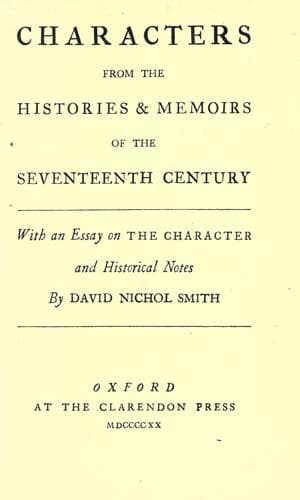
Characters from the Histories & Memoirs of the Seventeenth Century — John Shaqi
Characters from the Histories & Memoirs of the Seventeenth Century
History
Characters from the Histories & Memoirs of the Seventeenth Century
Great Britain -- Biography; Great Britain -- History -- Stuarts, 1603-1714
There is a broad distinction between his earlier and later characters.
While he was still in the midst of the conflict and hoped to influence
it by stating what he knew, he depicted the individual in relation
to events. When the conflict was over and he was at leisure to draw
on his recollections, he made the individual to a greater degree the
representative of the type. But the distinction is not clearly marked,
and Clarendon may not have suspected it. His habitual detachment was
assisted by his exile. The displeasure of his ungrateful master, from
whom he had never been separated during seventeen difficult years, had
proved the vanity of the little things of life. He looked at men from
a distance that obscures what is insignificant, and shows only the
essential.
All his characters are clearly defined. We never confound them; we
never have any doubt of how he understood them. He sees men as a whole
before he begins to describe them, and then his only difficulty, as
his manuscripts show, is to make his pen move fast enough. He does not
build up his characters. He does not, as many others do, start with
the external features in the hope of arriving at the central facts. He
starts from the centre and works outwards. This is the reason of the
convincingness of his characters, their dramatic truth. The dramatic
sense in him is stronger than the pictorial.
He troubles little about personal appearance, or any of the traits
which would enable us to visualize his men. We understand them rather
than see them. Hampden, he tells us, was 'of a most civil and affable
deportment' and had 'a flowing courtesy to all men', a 'rare temper
and modesty'; it is Sir Philip Warwick who speaks of the 'scurf
commonly on his face'.[14] He says that the younger Vane 'had an
unusual aspect', and leaves us wondering what was unusual. His
Falkland is an exception, but he adopted a different scale when
describing his greatest friend and only hero. Each of his two accounts
of Falkland is in fact a brief biography rather than a character;
the earliest of them, written shortly after Falkland's death, he once
thought of making into a volume by itself. In his characters proper
he confines himself more strictly than any other writer to matters of
character. They are characters rather than portraits.
But portraiture was one of his passions, though he left its practice
to the painters. He adorned his houses with the likenesses of his
friends. It was fitting that our greatest character writer should
have formed one of the great collections of pictures of 'wits, poets,
philosophers, famous and learned Englishmen'.[15] To describe them
on paper, and to contrive that they should look down on him from his
walls, were different ways of indulging the same keen and tireless
interest in the life amid which he moved.
Public-domain text, read in full here on John Shaqi.
Reviews
Reviews
No reviews yet
Be the first to share your thoughts on this work.
Join the Discussion
Join the discussion
Sign in to leave a comment or review.
Sign InorCreate an account