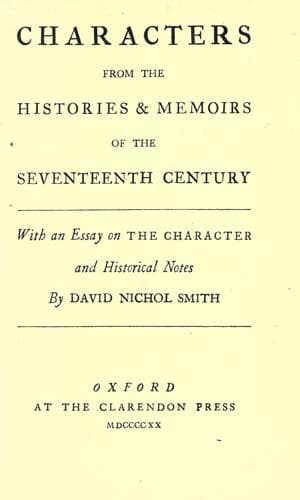
Characters from the Histories & Memoirs of the Seventeenth Century — John Shaqi
Characters from the Histories & Memoirs of the Seventeenth Century
History
Characters from the Histories & Memoirs of the Seventeenth Century
Great Britain -- Biography; Great Britain -- History -- Stuarts, 1603-1714
inferiority in learning and brilliance and the gentler virtues,
yet trusting to his own judgement, and convinced that every man
worth knowing has a pronounced individuality. In these happy and
irresponsible days, when he numbered poets among his friends, he
himself wrote poetry. Little of it is preserved. He contributed
introductory verses to Davenant's _Albovine_, and composed verses on
the death of Donne. His poetry was well enough known for Dryden to
allude to it during his Lord Chancellorship, in the address presented
to him at the height of his power in 1662:
The _Muses_, who your early Courtship boast,
Though now your Flames are with their Beauty lost,
Yet watch their Time, that if you have forgot
They were your Mistresses, the world may not.
But first the law claimed him, and then politics, and then came the
Civil War. As Privy Councillor and Chancellor of the Exchequer he was
in the thick of the conflict. The men whom he had now to study were
men of affairs. He had the clear and unimpassioned vision which often
goes with a warm temperament, and could scrutinize his friends without
endangering his affection for them. However deeply his feelings might
be engaged, he had taken a pleasure in trying to see them exactly as
they were. When he came to judge his political enemies he continued
the same attitude of detachment, and studiously cultivated it. 'I am
careful', he said in a private letter,[12] 'to do justice to every
man who hath fallen in the quarrel, on which side soever.' 'I know
myself', he said in the _History_,[13] 'to be very free from any of
those passions which naturally transport men with prejudice towards
the persons whom they are obliged to mention, and whose actions they
are at liberty to censure.' It was beyond human nature for a man who
had lived through what he did to be completely unprejudiced. He did
not always scrupulously weigh what he knew would be to the discredit
of the Parliamentary leaders, nor did he ignore mere Royalist rumour,
as in the character of Pym. But his characters of them are often more
favourable than might have been expected. He may show his personal
dislike, or even his sense of their crime, but behind this he permits
us to see the qualities which contributed to their success. There can
be no reasonable objection to his characters of Hampden and Cromwell.
Political partisans find them disappointing, and they are certainly
not the final verdict. The worst that can be said of them is that
they are drawn from a wrong point of view; but from that point of view
their honesty is unquestionable. He does not distinguish men by their
party. The folly of his own side is exhibited as relentlessly as the
knavery of his opponents. Of no one did he write a more unfavourable
character than the Earl of Arundel. He explains the failure of Laud,
and he does not conceal the weakness of Charles.
Public-domain text, read in full here on John Shaqi.
Reviews
Reviews
No reviews yet
Be the first to share your thoughts on this work.
Join the Discussion
Join the discussion
Sign in to leave a comment or review.
Sign InorCreate an account