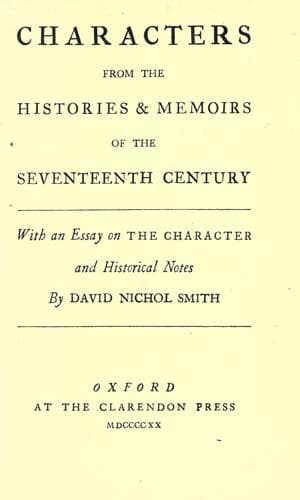
Characters from the Histories & Memoirs of the Seventeenth Century
History
Characters from the Histories & Memoirs of the Seventeenth Century
Great Britain -- Biography; Great Britain -- History -- Stuarts, 1603-1714
With all his shrewd observation, it must be admitted that his range of
comprehension was limited. There were no types of character too subtle
for Clarendon to understand. There were some which eluded Burnet's
grasp. He is at his best in describing such a man as Lauderdale, where
the roughness of the style is in perfect keeping with the subject.
His character of Shaftesbury, whom he says he knew for many years in a
very particular manner, is a valuable study and a remarkable companion
piece to Dryden's _Achitophel_. But he did not understand Halifax. The
surface levity misled him. He tells us unsuspectingly as much about
himself as about Halifax. He tells us that the Trimmer could never be
quite serious in the good bishop's company.
We learn more about Halifax from his own elaborate study of Charles
II. It is a prolonged analysis by a man of clear vision, and perfect
balance of judgement, and no prepossessions; who was, moreover, master
of the easy pellucid style that tends to maxim and epigram. A more
impartial and convincing estimate of any king need never be expected.
In method and purpose, it stands by itself. It is indeed not so
much a character in the accepted sense of the word as a scientific
investigation of a personality. Others try to make us see and
understand their men; Halifax anatomizes. Yet he occasionally permits
us to discover his own feelings. Nothing disappointed him more in the
merry monarch than the company he kept, and his comprehensive taste in
wit. 'Of all men that ever _liked_ those who _had wit_, he could the
best _endure_ those who had _none_': there is more here than is on the
surface; we see at once Charles, and his court, and Halifax himself.
As a class, the statesmen and politicians more than hold their
own with the other character writers of the seventeenth century.
Shaftesbury's picture of Henry Hastings, a country gentleman of the
old school, who carried well into the Stuart period the habits and
life of Tudor times, shows a side of his varied accomplishments which
has not won the general recognition that it deserves. It is a sketch
exactly in the style of the eighteenth century essayists. It makes us
regret that the fragmentary autobiography in which it is found did not
come down to a time when it could have included sketches of his famous
contemporaries. The literary skill of his grandson, the author of the
_Characteristicks_, was evidently inherited.
Public-domain text, read in full here on John Shaqi.
Reviews
Reviews
No reviews yet
Be the first to share your thoughts on this work.
Join the Discussion
Join the discussion
Sign in to leave a comment or review.
Sign InorCreate an account