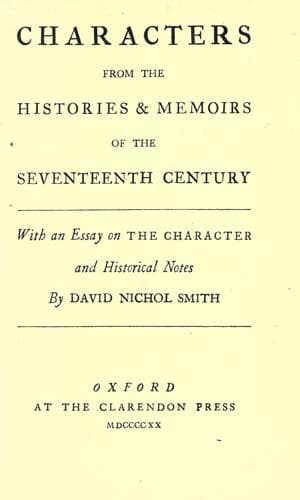
Characters from the Histories & Memoirs of the Seventeenth Century — John Shaqi
Characters from the Histories & Memoirs of the Seventeenth Century
History
Characters from the Histories & Memoirs of the Seventeenth Century
Great Britain -- Biography; Great Britain -- History -- Stuarts, 1603-1714
Sir Philip Warwick has the misfortune to be overshadowed by Clarendon.
As secretary to Charles I in the year before his execution, and as
a minor government official under Charles II, he was well acquainted
with men and affairs. Burnet describes him as 'an honest but a weak
man', and adds that 'though he pretended to wit and politics, he was
not cut out for that, and least of all for writing of history'. He
could at least write characters. They do not bear the impress of a
strong personality, but they have the fairmindedness and the calm
outlook that spring from a gentle and unassertive nature. His Cromwell
and his Laud are alike greatly to his credit; and the private view
that he gives us of Charles has unmistakable value. His _Mémoires_
remained in manuscript till 1701, the year before the publication of
Clarendon's _History_. It was the first book to appear with notable
characters of the men of the Civil Wars and the Protectorate.
The Histories and Memoirs of the seventeenth century contain by far
the greatest number of its characters; but they are to be found also
in scattered Lives, and in the collections of material that mark the
rise of modern English biography. There are disappointingly few by
Fuller. In his _Worthies of England_ he is mainly concerned with the
facts of a man's life, and though, in his own word, he fleshes the
bare skeleton of time, place, and person with pleasant passages,
and interlaces many delightful stories by way of illustrations, and
everywhere holds us by the quaint turns of his fertile fancy, yet the
scheme of the book did not involve the depicting of character, nor did
it allow him to deal with many contemporaries whom he had known. In
the present volume it has therefore been found best to represent him
by the studies of Bacon and Laud in his _Church-History_. Bacon he
must have described largely from hearsay, but what he says of Laud is
an admirable specimen of his manner, and leaves us wishing that he had
devoted himself in larger measure to the worthies of his own time.
There are no characters in Aubrey's _Brief Lives_, which are only a
series of rough jottings by a prince of gossips, who collected what
he could and put it all on paper 'tumultuarily'. But the extracts from
what he says of Hobbes and Milton may be considered as notes for a
character, details that awaited a greater artist than Aubrey was to
work them into a picture; and if Hobbes and Milton are to be given a
place, as somehow or other they must be, in a collection of the kind
that this volume offers, there is no option but to be content with
such notes, for there is no set character of either of them. The value
of the facts which Aubrey has preserved is shown by the use made of
them by all subsequent biographers, and notably by Anthony à Wood,
whose _Athenæ Oxonienses_ is our first great biographical dictionary.
Public-domain text, read in full here on John Shaqi.
Reviews
Reviews
No reviews yet
Be the first to share your thoughts on this work.
Join the Discussion
Join the discussion
Sign in to leave a comment or review.
Sign InorCreate an account