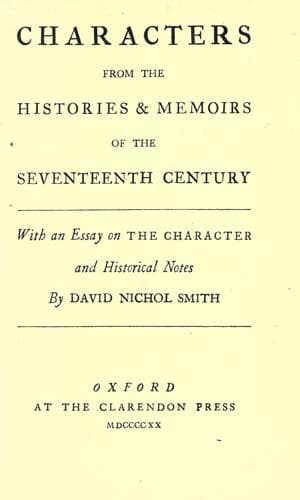
Characters from the Histories & Memoirs of the Seventeenth Century
History
Characters from the Histories & Memoirs of the Seventeenth Century
Great Britain -- Biography; Great Britain -- History -- Stuarts, 1603-1714
Yet the seventeenth century did not know its richness. None of its
best characters were then printed. The writers themselves could not
have suspected how many others were similarly engaged, so far were
they from belonging to a school. The characters in Clarendon's
_History of the Rebellion_ were too intimate and searching to be
published at once, and they remained in manuscript till about
thirty years after his death. In the interval Burnet was drawing the
characters in his _History of His Own Time_. He, like Clarendon,
was not aware of being indebted to any English model. Throughout the
period which they cover there are the characters by Fuller, Sir Philip
Warwick, Baxter, Halifax, Shaftesbury, and many others, the Latin
characters by Milton, and the verse characters by Dryden. There is no
sign that any of these writers copied another or tried to emulate
him. Together, but with no sense of their community, they made the
seventeenth century the great age of the character in England.
I. The Beginnings.
The art of literary portraiture in the seventeenth century developed
with the effort to improve the writing of history. Its first and at
all times its chief purpose in England was to show to later ages what
kind of men had directed the affairs and shaped the fortunes of
the nation. In France it was to be practised as a mere pastime; to
sketch well-known figures in society, or to sketch oneself, was for
some years the fashionable occupation of the salons. In England the
character never wholly lost the qualities of its origin. It might be
used on occasion as a record of affection, or as a weapon of political
satire; but our chief character writers are our historians. At the
beginning of the seventeenth century England was recognized to be
deficient in historical writings. Poetry looked back to Chaucer as its
father, was proud of its long tradition, and had proved its right to
sing the glories of Elizabeth's reign. The drama, in the full vigour
of its youth, challenged comparison with the drama of Greece and Rome.
Prose was conscious of its power in exposition and controversy. But in
every review of our literature's great achievement and greater promise
there was one cause of serious misgivings. England could not yet rank
with other countries in its histories. Many large volumes had been
printed, some of them containing matter that is invaluable to the
modern student, but there was no single work that was thought to
be worthy of England's greatness. The prevailing type was still the
chronicle. Even Camden, 'the glory and light of the kingdom', as Ben
Jonson called him, was an antiquary, a collector, and an annalist.
History had yet to be practised as one of the great literary arts.
Public-domain text, read in full here on John Shaqi.
Reviews
Reviews
No reviews yet
Be the first to share your thoughts on this work.
Join the Discussion
Join the discussion
Sign in to leave a comment or review.
Sign InorCreate an account