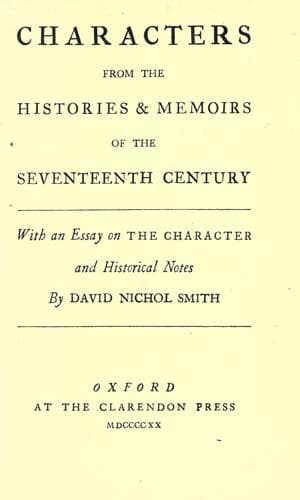
Characters from the Histories & Memoirs of the Seventeenth Century
History
Characters from the Histories & Memoirs of the Seventeenth Century
Great Britain -- Biography; Great Britain -- History -- Stuarts, 1603-1714
Bacon pointed out the 'unworthiness' and 'deficiences' of English
history in his _Advancement of Learning_.[1] 'Some few very worthy,
but the greater part beneath mediocrity' was his verdict on modern
histories in general. He was not the first to express these views.
Sir Henry Savile had been more emphatic in his dedication to Queen
Elizabeth of his collection of early chronicles, _Rerum Anglicarum
Scriptores post Bedam_, published in 1596.[2] And after Bacon,
somewhere about 1618, these views were again expressed by Edmund
Bolton in his _Hypercritica, or a Rule of Judgement for writing or
reading our Histories_.[3] 'The vast vulgar Tomes', he said, 'procured
for the most part by the husbandry of Printers, and not by appointment
of the Prince or Authority of the Common-weal, in their tumultuary and
centonical Writings do seem to resemble some huge disproportionable
Temple, whose Architect was not his Arts Master'. He repeated what he
calls the common wish 'that the majesty of handling our history might
once equal the majesty of the argument'. England had had all other
honours, but only wanted a history.
But the most valuable statement on the conditions of English history
at this time and the obstacles that hindered its progress was made by
Sir John Hayward at the beginning of his _Lives of the III Normans,
Kings of England_, published in 1613. Leaving aside the methods of the
chroniclers, he had taken the classical historians as his model in
his _First Part of the Life and raigne of King Henrie the IIII_. The
interest of this work to the modern reader lies in its structure, its
attempt at artistic unity, its recognition that English history must
be written on a different plan, rather than in its historical matter.
But it was no sooner published than Hayward was committed to the
Tower because the account of the deposition of Richard II was held
to be treasonable, the offence being aggravated by the dedication,
in perfectly innocent terms, to the Earl of Essex. His work was thus
checked till he met with encouragement from Henry, Prince of Wales,
a patron of literature, of whom, though a mere youth, such men as
Jonson, Chapman, and Raleigh, spoke with an enthusiasm that cannot be
mistaken for flattery. Prince Henry saw the need of a worthy history
of England. He therefore sent for Hayward to discuss the reasons with
him:
Prince Henry ... sent for mee, a few monethes before his
death. And at my second comming to his presence, among some
other speeches, hee complained much of our Histories of
England; and that the English Nation, which is inferiour to
none in Honourable actions, should be surpassed by all, in
leauing the memorie of them to posteritie....
Public-domain text, read in full here on John Shaqi.
Reviews
Reviews
No reviews yet
Be the first to share your thoughts on this work.
Join the Discussion
Join the discussion
Sign in to leave a comment or review.
Sign InorCreate an account