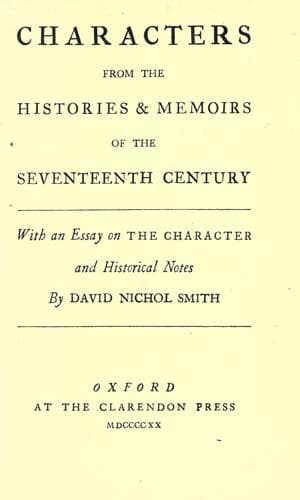
Characters from the Histories & Memoirs of the Seventeenth Century — John Shaqi
Characters from the Histories & Memoirs of the Seventeenth Century
History
Characters from the Histories & Memoirs of the Seventeenth Century
Great Britain -- Biography; Great Britain -- History -- Stuarts, 1603-1714
Lives of English men of letters begin in the seventeenth century,
and from Rawley's _Life of Bacon_, Sprat's _Life of Cowley_, and the
anonymous _Life of Fuller_ it is possible to extract passages which
are in effect characters. But Walton's _Lives_, the best of all
seventeenth century Lives, refuse to yield any section, for each of
them is all of a piece; they are from beginning to end continuous
character studies, revealing qualities of head and heart in their
affectionate record of fact and circumstance. There is therefore
nothing in this volume from his _Life of Donne_ or his _Life of
Herbert_. As a rule the characters that can be extracted from Lives
are much inferior to the clearly defined characters that are inserted
in Histories. The focus is not the same. When an author after dealing
with a man's career sums up his mental and moral qualities in a
section by itself, he does not trust to it alone to convey the total
impression. He is too liable also to panegyric, like Rawley, who could
see no fault in his master Bacon, or Sprat who, in Johnson's words,
produced a funeral oration on Cowley. There are no characters
of scholars or poets so good as Clarendon's Hales, or Earle, or
Chillingworth, or Waller; and for this reason, that Clarendon
envisages them, not as scholars or poets but as men, and gains a
definite and complete effect within small compass.
Roger North made his life of his brother Lord Keeper Guilford an
account of the bench and bar under Charles II and James II. Of its
many sketches of lawyers whom he or his brother had known, none is
so perfect in every way as the character of Chief Justice Saunders, a
remarkable man in real life who still lives in North's pages with
all his eccentricities. North writes at length about his brother,
yet nowhere do we see and understand him so clearly as we see and
understand Saunders. The truth is that a life and a character have
different objects and methods and do not readily combine. It is only
a small admixture of biography that a character will endure. And with
the steady development of biography the character declined.
A character must be short; and it must be entire, the complete
expression of a clear judgement. The perfect model is provided
by Clarendon. He has more than formal excellence. 'Motives', said
Johnson, 'are generally unknown. We cannot trust to the characters
we find in history, unless when they are drawn by those who knew the
persons; as those, for instance, by Sallust and by Lord Clarendon.'[4]
[Footnote 1: Letter to Pepys, January 20, 1703; Pepys's _Diary_, ed.
Braybrooke, 1825, vol. ii, p. 290.]
[Footnote 2: 'Short Remarks on Bishop Burnet's _History_,' _ad init._]
[Footnote 3: _History_, preface]
[Footnote 4: Boswell, 1769, ed. G.B. Hill, vol. ii, p. 79.]
* * * * *
Public-domain text, read in full here on John Shaqi.
Reviews
Reviews
No reviews yet
Be the first to share your thoughts on this work.
Join the Discussion
Join the discussion
Sign in to leave a comment or review.
Sign InorCreate an account