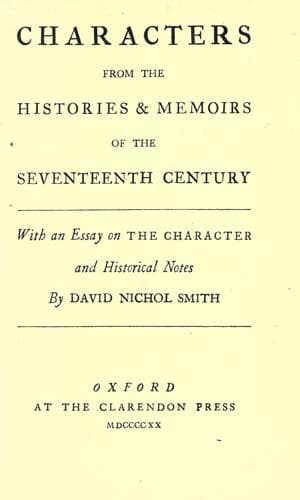
Characters from the Histories & Memoirs of the Seventeenth Century — John Shaqi
Characters from the Histories & Memoirs of the Seventeenth Century
History
Characters from the Histories & Memoirs of the Seventeenth Century
Great Britain -- Biography; Great Britain -- History -- Stuarts, 1603-1714
The character was definitely introduced into English literature when
the historians took as their subjects contemporary or recent events
at home, and, abandoning the methods of the chronicle, fashioned their
work on classical models. Its introduction had been further prepared
to some extent by the growing interest in lives, which, unlike
chronicles that recorded events, recognized the part played by men
in the control of events. In his _Advancement of Learning_ Bacon
regretted that Englishmen gave so little thought to describing the
deeds and characters of their great countrymen. 'I do find strange',
he said, 'that these times have so little esteemed the virtues of the
times, as that the writing of lives should be no more frequent.' He
and Hayward both wrote lives with the consciousness that their methods
were new in English, though largely borrowed from the classics.[6]
Hayward tried to produce a picture of the period he dealt with,
and his means for procuring harmoniousness of design was to centre
attention on the person of the sovereign. It is a conception of
history not as a register of facts but as a representation of the
national drama. His _Henry IV_ gives the impression, especially by its
speeches, that he looked upon history as resolving itself ultimately
into a study of men; and it thus explains how he wished to be free
to describe the times wherein he lived. He is on the whole earlier
than Bacon, who wrote his _Historie of the Reigne of King Henry the
Seventh_ late in life, during the leisure that was forced on him
by his removal from all public offices. Written to display the
controlling policy in days that were 'rough, and full of mutations,
and rare accidents', it is a study of the statecraft and character of
a king who had few personal gifts and small capacity for a brilliant
part, yet won by his ready wisdom the best of all praises that 'what
he minded he compassed'. How he compassed it, is what interested
Bacon. 'I have not flattered him,' he says, 'but took him to the life
as well as I could, sitting so far off, and having no better light.'
Would that Bacon had felt at liberty to choose those who sat near at
hand. Who better than the writer of the _Essays_ could have painted a
series of miniatures of the courts of Elizabeth and James?
Public-domain text, read in full here on John Shaqi.
Reviews
Reviews
No reviews yet
Be the first to share your thoughts on this work.
Join the Discussion
Join the discussion
Sign in to leave a comment or review.
Sign InorCreate an account