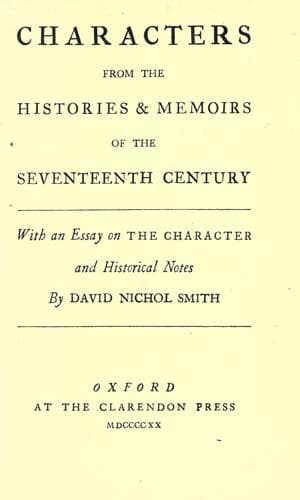
Characters from the Histories & Memoirs of the Seventeenth Century
History
Characters from the Histories & Memoirs of the Seventeenth Century
Great Britain -- Biography; Great Britain -- History -- Stuarts, 1603-1714
When at last the political upheaval of this century compelled men to
leave, whether in histories, or memoirs, or biographies, a record of
what they had themselves experienced, the character attained to its
full importance and excellence. 'That posterity may not be deceaved
by the prosperous wickednesse of these tymes, into an opinyon, that
lesse then a generall combination and universall apostacy in the whole
Nacion from their religion and allegiaunce could in so shorte a tyme
have produced such a totall and prodigious alteration and confusion
over the whole kingdome, and so the memory of those few who out of
duty and conscience have opposed and resisted that Torrent which hath
overwhelmed them, may loose the recompence dew to ther virtue, and
havinge undergone the injuryes and reproches of this, may not finde
a vindication in a better Age'--in these words Clarendon began his
_History of the Rebellion_. But he could not vindicate the memory
of his political friends without describing the men who had overcome
them. The history of these confused and difficult years would not be
properly understood if the characters of all the chief actors in the
tragic drama were not known. For to Clarendon history was the record
of the struggle of personalities. When we are in the midst of a
crisis, or view it from too near a distance, it is natural for us
to think of it as a fight between the opposing leaders, and the
historians of their own time are always liable to attribute to the
personal force of a statesman what is due to general causes of which
he is only the instrument. Of these general causes Clarendon took
little account. 'Motives which influenced masses of men', it has been
said, 'escape his appreciation, and the _History of the Rebellion_
is accordingly an account of the Puritan Revolution which is
unintelligible because the part played by Puritanism is misunderstood
or omitted altogether'.[7] But the _History of the Rebellion_ is a
Stuart portrait gallery, and the greatest portrait gallery in the
English language.
[Footnote 1: Book II, ed. Aldis Wright, pp. 92-5.]
[Footnote 2: 'Historæ nostræ particulam quidam non male: sed qui totum
corpus ea fide, eaque dignitate scriptis complexus sit, quam suscepti
operis magnitudo postularet, hactenus plane neminem extitisse
constat.... Nostri ex fæce plebis historici, dum maiestatem tanti
operis ornare studuerunt, putidissimis ineptiis contaminarunt. Ita
factum est nescio qua huiusce insulæ infoelicitate, ut maiores tui,
(serenissima Regina) viri maximi, qui magnam huius orbis nostri partem
imperio complexi, omnes sui temporis reges rerum gestarum gloria
facile superarunt, magnorum ingeniorum quasi lumine destituti, iaceant
ignoti, & delitescant.']
[Footnote 3: _Critical Essays of the Seventeenth Century_, ed.
Spingarn, vol. i, pp. 82-115.]
[Footnote 4: See also Camden Society Publications, No. 7, 1840.]
Public-domain text, read in full here on John Shaqi.
Reviews
Reviews
No reviews yet
Be the first to share your thoughts on this work.
Join the Discussion
Join the discussion
Sign in to leave a comment or review.
Sign InorCreate an account