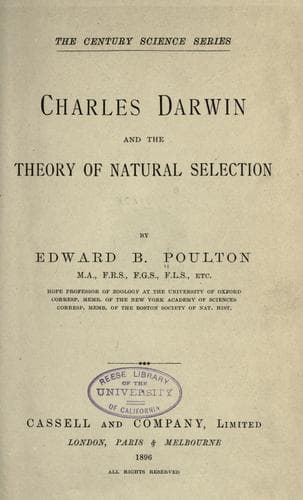
Charles Darwin and the Theory of Natural SelectionPoulton, Edward Bagnall, Sir
Science
Charles Darwin and the Theory of Natural Selection
Poulton, Edward Bagnall, Sir
Darwin, Charles, 1809-1882; Natural selection
The last letter, deeply interesting both on its own account and because
it was written so near the end of Darwin’s life, was a reply to one
from Meldola in which he had said that the publishers were complaining
that the list of subscribers was disappointing, and that they had
expressed the wish that Mr. Darwin could see his way to writing a much
longer introductory notice than he had done.
“_Feb. 2nd [1882]._
“Down.
“DEAR MR. MELDOLA,--I am very sorry that I can add nothing to
my very brief notice without reading again Weismann’s work and
getting up the whole subject by reading my own and other books,
and for so much labour I have not strength. I have now been
working at other subjects for some years, and when a man grows
as old as I am, it is a great wrench to his brain to go back to
old and half-forgotten subjects. You would not readily believe
how often I am asked questions of all kinds, and quite lately I
have had to give up much time to do a work, not at all concerning
myself, but which I did not like to refuse. I must however
somewhere draw the line, or my life will be a misery to me.
“I have read your Preface and it seems to me _excellent_. I
am sorry in many ways, including the honour of England as a
scientific country, that your translation has as yet sold badly.
Does the publisher or do you lose by it? If the publisher, though
I should be sorry for him, yet it is in the way of business; but
if you yourself lose by it, I earnestly beg you to allow me to
subscribe a trifle, viz. ten guineas, towards the expense of this
work, which you have undertaken on public grounds.
“Pray believe me, yours very faithfully,
“CH. DARWIN.”
Darwin’s generous offer, although gratefully declined, was a warm
encouragement in the laborious, and in some respects thankless, task of
translator and editor--a task which, in the case of the English edition
of Weismann’s “Studies in the Theory of Descent,” was carried out in so
admirable a manner.
CHAPTER XXVI.
HIS LAST ILLNESS (1882).
In the last few months of his life, towards the end of 1881 and
beginning of 1882, Darwin began to suffer from his heart, causing
attacks of pain and faintness which increased in number. On March 7th,
1882, he had one of these seizures when walking, “and this was the last
time that he was able to reach his favourite ‘sand-walk’” (“Life and
Letters”). After this he became rather better, and on April 17th was
able to record the progress of an experiment for his son Francis. The
following sentences are quoted from the “Life and Letters”:--
Public-domain text, read in full here on John Shaqi.
Reviews
Reviews
No reviews yet
Be the first to share your thoughts on this work.
Elsewhere in the archive
Join the Discussion
Join the discussion
Sign in to leave a comment or review.
Sign InorCreate an account