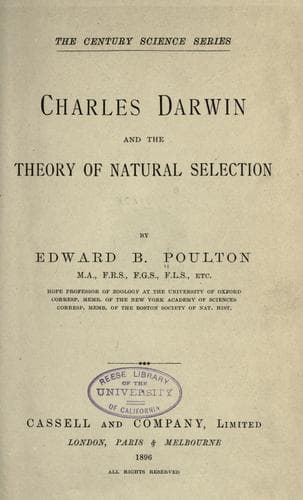
Charles Darwin and the Theory of Natural SelectionPoulton, Edward Bagnall, Sir
Science
Charles Darwin and the Theory of Natural Selection
Poulton, Edward Bagnall, Sir
Darwin, Charles, 1809-1882; Natural selection
“During the night of April 18th, about a quarter to twelve, he
had a severe attack and passed into a faint, from which he was
brought back to consciousness with very great difficulty. He
seemed to recognise the approach of death, and said, ‘I am not
the least afraid to die.’ All the next morning he suffered from
terrible nausea and faintness, and hardly rallied before the end
came.
“He died at about four o’clock on Wednesday, April 19th, 1882.”
He was buried in Westminster Abbey on April 26th.
Thus died one of the greatest of men, after a life of patient and
continuous work interrupted only by ill-health; a man who was, perhaps,
more widely attacked and more grossly misrepresented than any other,
but who lived to see his teachings almost universally received; a
man whose quiet, peaceful life of work, and whose precarious health,
prevented that large intercourse with his fellow-men which is generally
forced upon greatness, but who was so beloved by his circle of intimate
friends that, through their contagious enthusiasm, and through the
glimpses of his nature revealed in his writings, he was in all
likelihood more greatly loved than any other man of his time by those
who knew him not.
And for all those of us who have loved Darwin, although we have never
seen him, we can at any rate remember that we have lived in his time
and have heard the echoes of his living voice; he has been even more
to us than he will be to future generations of mankind--a mighty
tradition, gaining rather than losing in force and in overwhelming
interest as each passing age, inspired by his example, guided by his
teachings, adds to the knowledge of nature, and in so doing gives an
ever deeper meaning to his life and work.
FOOTNOTES
[A] See Professor Meldola’s interesting Presidential Address to the
Entomological Society of London (January, 1896) on the use of the
imagination in science, printed in the Transactions of the Society and
in _Nature_. See also “The Advancement of Science” (London, 1890), in
which Professor Lankester maintains (p. 4): “All true science deals
with speculation and hypothesis, and acknowledges as its most valued
servant--its indispensable ally and helpmeet--that which our German
friends call ‘Phantasie’ and we ‘the Imagination.’” Consult also
Professor Tyndall’s essay “On the Scientific Use of the Imagination”
(“Fragments of Science,” 1889, vol. ii., p. 101).
[B] We are told in the “Life and Letters” that the last proof of the
“Journal” was finished in 1837. The Diary, as stated above, was written
between July, 1837, and February, 1838.
[C] Professor H. F. Osborn has rightly urged that this essay should be
published (“From the Greeks to Darwin,” 1894, p. 235).
Public-domain text, read in full here on John Shaqi.
Reviews
Reviews
No reviews yet
Be the first to share your thoughts on this work.
Elsewhere in the archive
Join the Discussion
Join the discussion
Sign in to leave a comment or review.
Sign InorCreate an account