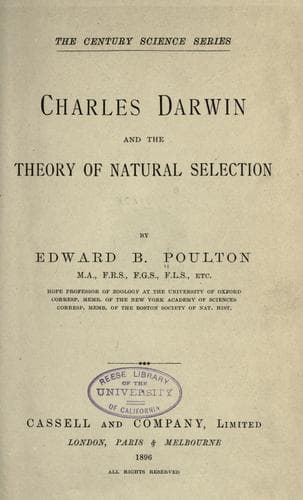
Charles Darwin and the Theory of Natural SelectionPoulton, Edward Bagnall, Sir
Science
Charles Darwin and the Theory of Natural Selection
Poulton, Edward Bagnall, Sir
Darwin, Charles, 1809-1882; Natural selection
During these years in London his health broke down many times; so that
he says, in the “Autobiography”: “I did less scientific work, though I
worked as hard as I possibly could, than during any other equal length
of time in my life.” He chiefly worked at his book on “The Structure
and Distribution of Coral Reefs,” published in 1842 (second edition in
1874). This work contains an account of Darwin’s well-known theory upon
the origin of the various coral formations--fringing reefs, barrier
reefs, and atolls--by the upward growth of the reef keeping pace with
the gradual sinking of the island upon which it is based, so that the
living corals always remain at the surface under the most favourable
conditions, while beneath them is an ever-thickening reef formed of
dead coral, until at length, by continuing this process, the climax
is reached in the atoll, in which the original island has altogether
disappeared beneath the surface of a central lagoon enclosed in a
ring formed by the living edge of the reef. This theory, after being
accepted for many years, has recently been disputed, chiefly as the
result of the observations made on the _Challenger_ expedition. It
is contended by Dr. John Murray “that it is not necessary to call in
subsidence to explain any of the characteristic features of barrier
reefs or atolls, and that all these features would exist alike in areas
of slow elevation, of rest, or of slow subsidence” (_Nature_, August
12th, 1880, p. 337). It cannot be said that this controversy is yet
settled, or that the supporters of either theory have proved that the
other does not hold--at any rate, in certain cases.
Among his geological papers written at this time was one describing the
glacial phenomena observed during a tour in North Wales. This paper
(_Philosophical Magazine_, 1842, p. 352) is placed by Sir Archibald
Geikie “almost at the top of the long list of English contributions to
the history of the Ice Age.”
At this time, too, he was reflecting and collecting evidence for
the great work of his life. Thus in January, 1841, he writes to his
cousin, Darwin Fox, asking for “all kinds of facts about ‘Varieties and
Species.’”
CHAPTER V.
DOWN--GEOLOGY OF THE VOYAGE--WORK ON CIRRIPEDES (1842–54).
From September 14th, 1842, until his death, Darwin resided at Down,
living a very retired life, and almost exclusively engaged in his
scientific researches. Although Down is only twenty miles from London,
it is three miles from the nearest railway station (Orpington), and is
only now for the first time receiving a telegraph office. A home in
such a place enabled Darwin to pursue his work without interruption,
remaining, at the same time, within easy reach of all the advantages of
London. Here, too, he had no difficulty in avoiding social engagements,
which always injured his very precarious health, and thus interfered
with work; although, at the same time, he could entertain in his own
house at such times as he felt able to do so.
Public-domain text, read in full here on John Shaqi.
Reviews
Reviews
No reviews yet
Be the first to share your thoughts on this work.
Join the Discussion
Join the discussion
Sign in to leave a comment or review.
Sign InorCreate an account