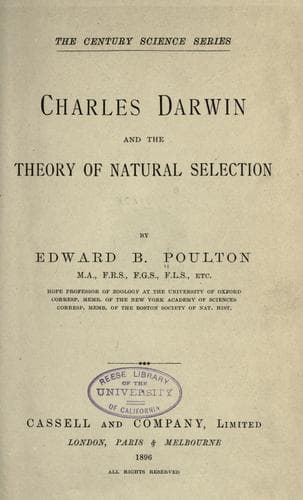
Charles Darwin and the Theory of Natural SelectionPoulton, Edward Bagnall, Sir
Science
Charles Darwin and the Theory of Natural Selection
Poulton, Edward Bagnall, Sir
Darwin, Charles, 1809-1882; Natural selection
“I have come to a fixed opinion that the plan of the first
describer’s name, being appended for perpetuity to a species, has
been the greatest curse to Natural History.... I feel sure as
long as species-mongers have their vanity tickled by seeing their
own names appended to a species, because they miserably described
it in two or three lines, we shall have the same _vast_ amount of
bad work as at present, and which is enough to dishearten any man
who is willing to work out any branch with care and time.”
And in another letter (February 4th) to the same correspondent:--
“In mineralogy I have myself found there is no rage to merely
name; a person does not take up the subject without he intends
to work it out, as he knows that his _only_ claim to merit rests
on his work being ably done, and has no relation whatever to
_naming_.... I do not think more credit is due to a man for
defining a species, than to a carpenter for making a box. But I
am foolish and rabid against species-mongers, or rather against
their vanity; it is useful and necessary work which must be done;
but they act as if they had actually made the species, and it was
their own property.”
A little later in the same year (1849) his health seems to have
determined him to give up the crusade, for he writes to Hooker (April
29th):--
“With health and vigour, I would not have shewn a white feather,
[and] with aid of half-a-dozen really good Naturalists, I
believe something might have been done against the miserable and
degrading passion of mere species naming.”
Anyone whose researches have been among the species of any much-worked
and much-collected zoological group will quite agree that synonymy is,
as Darwin found it, heart-breaking work; and although there may be
good reasons why the system of appending the describer’s name must be
retained, such a protest as that raised in these letters cannot fail to
do good in drawing attention to an abuse which is only too common, and
which introduces unnecessary difficulty and gratuitous confusion into
the study of Nature.
[Sidenote: DEATH OF HIS FATHER.]
His father, Dr. Darwin, died November 13th, 1848, at the age of
eighty-three, when he was so much out of health that he was unable to
attend the funeral. In 1851 he lost his little daughter Annie, who died
at Malvern, April 23rd. A few days after her death he wrote a most
affecting account of her--a composition of great beauty and pathos.
CHAPTER VI.
THE GROWTH OF THE “ORIGIN OF SPECIES” (1837–58).
Public-domain text, read in full here on John Shaqi.
Reviews
Reviews
No reviews yet
Be the first to share your thoughts on this work.
Join the Discussion
Join the discussion
Sign in to leave a comment or review.
Sign InorCreate an account