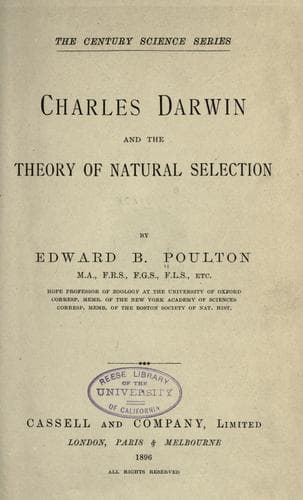
Charles Darwin and the Theory of Natural SelectionPoulton, Edward Bagnall, Sir
Science
Charles Darwin and the Theory of Natural Selection
Poulton, Edward Bagnall, Sir
Darwin, Charles, 1809-1882; Natural selection
In dealing with this subject in his “Autobiography,” Darwin tells us
of his reflections whilst on the voyage of the _Beagle_, and here
mentions another observation which deeply impressed him in addition
to those which he again repeats, on the relation between the living
and the dead in the same area and on the productions of the Galapagos
Archipelago--viz. “the manner in which closely allied animals replace
one another in proceeding southwards over the continent” (of South
America). On the theory of separate creation the existence of such
representative species received no explanation, although it became
perfectly intelligible on the theory that a single species may be
modified into distinct, although nearly related, species in the course
of its range over a wide geographical area. Here, too, the evidence
is in favour of evolution simply, and does not point to any cause of
evolution.
He also implies that even at this time he regarded the beautiful
adaptations or contrivances of nature by which organisms are fitted
to their habits of life--“for instance, a woodpecker or a tree-frog
to climb trees, or a seed for dispersal by hooks or plumes”--as the
most striking and important phenomena of the organic world, and the
one great difficulty in the path of any naturalist who should attempt
to supply a motive force for evolution. And he regarded the previous
attempts at an explanation--the direct action of surroundings and the
will of the organism--as inadequate because they could not account for
such adaptations.
Therefore being convinced of evolution, but as yet unprovided with a
motive cause which in any way satisfied him, he began in July, 1837,
shortly after his return home from the _Beagle_, to collect all facts
which bore upon the modifications which man has induced in the animals
and plants which he has subjugated, following, as he tells us, the
example of Lyell in geology. He goes on to say in his “Autobiography”:--
“I soon perceived that selection was the key-stone of man’s
success in making useful races of animals and plants. But how
selection could be applied to organisms living in a state of
nature remained for some time a mystery to me.”
[Sidenote: COLLECTION OF NOTES.]
Public-domain text, read in full here on John Shaqi.
Reviews
Reviews
No reviews yet
Be the first to share your thoughts on this work.
Join the Discussion
Join the discussion
Sign in to leave a comment or review.
Sign InorCreate an account