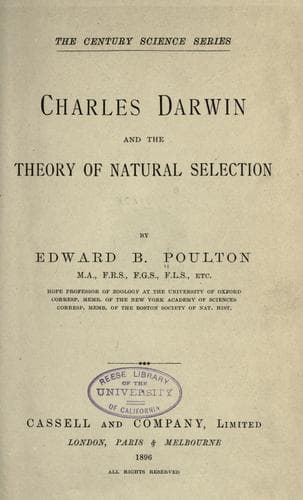
Charles Darwin and the Theory of Natural Selection — John Shaqi
Charles Darwin and the Theory of Natural SelectionPoulton, Edward Bagnall, Sir
Science
Charles Darwin and the Theory of Natural Selection
Poulton, Edward Bagnall, Sir
Darwin, Charles, 1809-1882; Natural selection
We see indications in the extracts from his note-book at this period
(viz. between July, 1837, and February, 1838), and before he had
arrived at the conception of Natural Selection, that he had the idea
of “laws of change” affecting species to some extent like the laws of
change which compel the individuals of every species to work out their
own development, the extinction of the one corresponding in a measure
to the death of the other. Thus he says, “It is a wonderful fact,
horse, elephant, and mastodon dying out about the same time in such
different quarters. Will Mr. Lyell say that some [same?] circumstance
killed it over a tract from Spain to South America? Never.” We know
that a few months later he would have himself accepted the view he
imputes to Lyell, and would have regarded the extinction as due to
some circumstance affecting the competition for food or some other
relationship with the organic life of the same district. It is probable
that the above quotation from his Diary was written in connection with
the conclusion of Chapter IX. of the first edition of the “Journal of
the Voyage” (pp. 211, 212); for the latter is a fuller exposition of
the same argument.[B]
“One is tempted to believe,” he says, “in such simple relations,
as variation of climate and food, or introduction of enemies,
or the increased numbers of other species, as the cause of the
succession of races. But it may be asked whether it is probable
that [“than” is an evident misprint in the original] any such
cause should have been in action during the same epoch over
the whole northern hemisphere, so as to destroy the _Elephas
primigenius_ on the shores of Spain, on the plains of Siberia,
and in Northern America.... These cases of extinction forcibly
recall the idea (I do not wish to draw any close analogy) of
certain fruit-trees, which, it has been asserted, though grafted
on young stems, planted in varied situations, and fertilized by
the richest manures, yet at one period have all withered away and
perished. A fixed and determined length of life has in such cases
been given to thousands and thousands of buds (or individual
germs), although produced in long succession.”
He then concludes that the animals of one species, although “each
individual appears nearly independent of its kind,” may be bound
together by common laws. He ends by arguing that the adaptations
of animals confined to certain areas cannot be related to the
peculiarities of climate or country, because other animals introduced
by man are often so much more successful than the aborigines. As to the
causes of extinction, “all that at present can be said with certainty
is that, as with the individual, so with the species, the hour of life
has run its course, and is spent.”
[Sidenote: EARLY VIEWS.]
Public-domain text, read in full here on John Shaqi.
Reviews
Reviews
No reviews yet
Be the first to share your thoughts on this work.
Join the Discussion
Join the discussion
Sign in to leave a comment or review.
Sign InorCreate an account