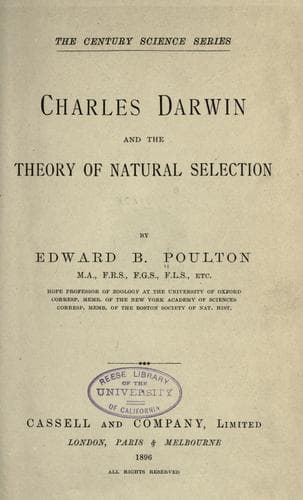
Charles Darwin and the Theory of Natural SelectionPoulton, Edward Bagnall, Sir
Science
Charles Darwin and the Theory of Natural Selection
Poulton, Edward Bagnall, Sir
Darwin, Charles, 1809-1882; Natural selection
The explanation of divergence of species during modification
(divergence of character) had not then occurred to him, and he tells us
in the “Autobiography”:--
“I can remember the very spot in the road, whilst in my carriage,
when to my joy the solution occurred to me; and this was long
after I had come to Down. The solution, as I believe, is that
the modified offspring of all dominant and increasing forms tend
to become adapted to many and highly diversified places in the
economy of nature.”
A good example of this tendency is seen in the relations of three great
vertebrate classes--mammals, birds, and fishes--to the environments for
which they are respectively fitted: earth, air, and water. Competition
is most severe between forms most nearly alike, and hence some measure
of relief from competition is afforded when certain members of each of
these classes enter the domain of one of the others. Hence, we observe
that although mammals as a whole are terrestrial, a small minority
are aërial and aquatic; although birds are aërial, a minority are
terrestrial and aquatic; although fishes are aquatic, a minority tend
to be, at any rate largely, terrestrial and aërial.
Huxley considered it “curious that so much importance should be
attached to this supplementary idea. It seems obvious that the theory
of the origin of species by natural selection necessarily involves
the divergence of the forms selected” (“Obituary,” 1888, reprinted
in “Darwiniana,” 1893; see pp. 280, 281). But Darwin showed that
divergence might be a great advantage in itself, and would then be
directly (and not merely incidentally and indirectly) encouraged and
increased by natural selection.
[Sidenote: RESOLVE TO PUBLISH.]
As soon as the 1844 sketch was finished, Darwin wrote a letter (July
5th) as his “solemn and last request” that his wife would, in the
case of his death, devote £400, or if necessary £500, in publishing
it, and would take trouble in promoting it. He suggests Lyell as the
best editor, then Edward Forbes, then Henslow (“quite the best in many
respects”), then Hooker (“would be _very_ good”), then Strickland.
After Strickland he had thought of Owen as “very good,” but added,
“I presume he would not undertake such a work.” If no editor could
be obtained, he requested that the essay should be published as it
was--stating that it was not intended for publication in its present
form. In August, 1854, he wrote on the back of the letter: “Hooker by
far best man to edit my Species volume.”
Public-domain text, read in full here on John Shaqi.
Reviews
Reviews
No reviews yet
Be the first to share your thoughts on this work.
Join the Discussion
Join the discussion
Sign in to leave a comment or review.
Sign InorCreate an account