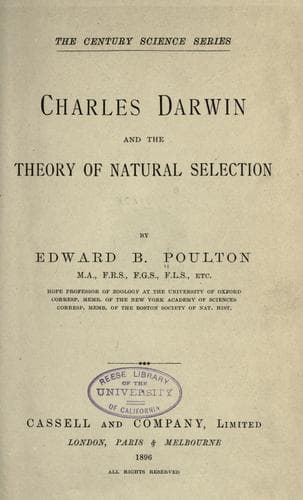
Charles Darwin and the Theory of Natural SelectionPoulton, Edward Bagnall, Sir
Science
Charles Darwin and the Theory of Natural Selection
Poulton, Edward Bagnall, Sir
Darwin, Charles, 1809-1882; Natural selection
All this shows how certain he felt that he was on firm ground, and that
his theory of natural selection was of vast importance to science. This
same strong conviction appears clearly in the first edition of the
“Origin,” and is undoubtedly one of the secrets of its power to move
the minds of men. Although the author is above all others fair-minded;
although he is most keen to discover and to bring forward all opposing
evidence, and to criticise most minutely everything favourable;
nevertheless, looking at the evidence as a whole, he has no doubt as
to its bearing, and feels, and shows that he feels, a magnificent
confidence in the truth and the importance of his theory.
CHAPTER VII.
GROWTH OF THE “ORIGIN” (_continued_)--CORRESPONDENCE WITH FRIENDS.
The great periods of Darwin’s scientific career are marked by intimate
friendships, which must be taken into account in attempting to trace
his mental development. Henslow was his intimate friend at Cambridge
and during the voyage of the _Beagle_. The influence of Lyell, through
his writings, was of the utmost importance during the voyage, and was
deepened by the close personal contact which took place on Darwin’s
return. Sir Joseph Hooker was his most intimate friend during the
growth of the “Origin of Species.”
Although Hooker met Darwin in 1839, their friendship did not begin
until four years later, when the former returned from the Antarctic
Expedition. On January 11th, 1844, Darwin wrote admitting his
conclusions on the question of evolution:--“At last gleams of light
have come,” he says, “and I am almost convinced (quite contrary to the
opinion I started with) that species are not (it is like confessing a
murder) immutable” (“Life and Letters,” Vol. II. p. 23).
[Sidenote: INQUIRIES AND EXPERIMENTS.]
From this point onwards his letters, especially to Hooker, indicate
the course he was following and the various problems he was considering
as they arose. Thus we find that he had finished reading Wollaston’s
“Insecta Maderensia” in 1855 (writing March 7th), and had been struck
with the very large proportion of wingless beetles, and had interpreted
the observation, viz. “that powers of flight would be injurious to
insects inhabiting a confined locality, and expose them to be blown
to the sea.” It is of great interest thus to witness the origin of a
theory which has since been universally accepted, and has received
confirmation from many parts of the world.
On April 11th of the same year he is experimenting on the powers of
resistance to immersion in salt water possessed by seeds, and he
writes an account of it to Hooker. The object of these experiments was
to throw light on the means by which plants have been transported to
islands.
Public-domain text, read in full here on John Shaqi.
Reviews
Reviews
No reviews yet
Be the first to share your thoughts on this work.
Join the Discussion
Join the discussion
Sign in to leave a comment or review.
Sign InorCreate an account