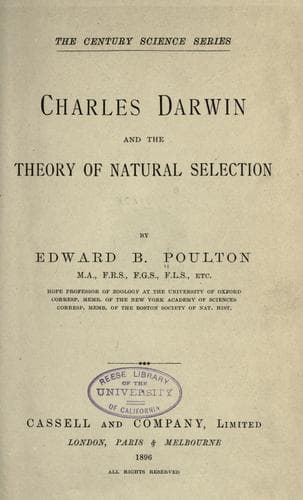
Charles Darwin and the Theory of Natural SelectionPoulton, Edward Bagnall, Sir
Science
Charles Darwin and the Theory of Natural Selection
Poulton, Edward Bagnall, Sir
Darwin, Charles, 1809-1882; Natural selection
At this period we get interesting evidence of his extraordinary insight
in the strong protests he makes against the Atlantis hypothesis
of Edward Forbes, and the other vast continental extensions which
naturalists did not hesitate to make in order to explain the existence
of species common to countries separated by wide tracts of the ocean.
These lost continents were as generally accepted as they were freely
proposed. And yet we find that, even then, one thinker far ahead of his
time saw clearly enough--as the _Challenger_ Expedition twenty years
later proved beyond all doubt--that the geological evidence is against
such extension, and that the means of distribution possessed by animals
are such as to render the supposition unnecessary.
In June, 1856, he writes to Lyell: “My blood gets hot with passion and
turns cold alternately at the geological strides, which many of your
disciples are taking”; and after mentioning the extension of continents
proposed by many leading naturalists, he says: “If you do not stop
this, if there be a lower region for the punishment of geologists, I
believe, my great master, you will go there. Why, your disciples in
a slow and creeping manner beat all the old Catastrophists who ever
lived! You will live to be the great chief of the Catastrophists.”
Lyell wrote disagreeing on the subject of continental extension; and
hence, on June 25th, 1856, Darwin replied in a long letter, giving
in detail his reasons for rejecting the hypothesis. He argued (1)
that the supposed extension of continents and fusion of islands would
be vast changes, giving the earth a new aspect, but that recent and
tertiary molluscs, etc., are distinct on opposite sides of the existing
continents; so that, although he did not doubt _great_ changes of level
in parts of continents, he concluded that “_fundamentally_ they stood
as barriers to the sea where they now stand” ever since the appearance
of living species; (2) that if a continent were nearly submerged, the
last remaining peaks would by no means always be volcanic, as are,
almost without exception, the oceanic islands; (3) that the amount of
subsidence which took place in continental areas during the Silurian
and Carboniferous periods--viz. during one tolerably uniform set of
beings--would not be enough to account for the depth of the ocean over
some parts of the site of the supposed submerged continents; (4) that
the supposed extensions are not consistent with the _absence_ of many
groups of animals--_e.g._ mammals, frogs, etc.--from islands.
Public-domain text, read in full here on John Shaqi.
Reviews
Reviews
No reviews yet
Be the first to share your thoughts on this work.
Join the Discussion
Join the discussion
Sign in to leave a comment or review.
Sign InorCreate an account