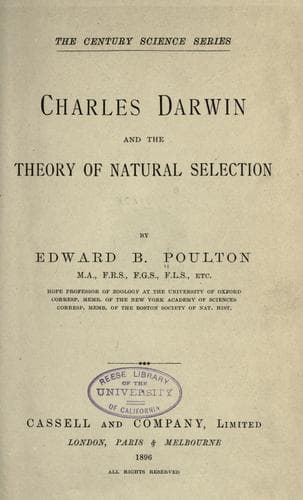
Charles Darwin and the Theory of Natural SelectionPoulton, Edward Bagnall, Sir
Science
Charles Darwin and the Theory of Natural Selection
Poulton, Edward Bagnall, Sir
Darwin, Charles, 1809-1882; Natural selection
In the same year began his correspondence with Asa Gray, who soon
became one of his warmest friends. He had numerous questions to ask
about the geographical range of plants, and in 1857 he wrote explaining
in some detail the views at which he had arrived as to the causes of
evolution.
My friend Rowland H. Wedgwood, a nephew of Darwin, has given me
the following interesting letter to his father, which was written,
he believes, probably before 1855. By kind permission, it is here
published for the first time. The letter is of great interest, as
throwing light upon his work, and also because of this early reference
to Huxley:--
“Down, _Sept. 5_.
“MY DEAR HARRY,--I am very much obliged for the Columbine seed
and for your note which made us laugh heartily.
“I had no idea what trouble the counting must have been, I had
not the least conception that there would have been so many pods.
I am very much interested on this point, and therefore to make
assurance sure, I repeat your figures viz. 560 and 742 pods on
two plants and 7200 on another. Does the latter number really
mean pods and not seeds? Upon my life I am sorry to give so much
trouble, but I should be VERY MUCH obliged for a few _average_
size pods, put up separately that I may count the seeds in each
pod: for though I counted the seeds in the pods sent before, I
hardly dare trust them without counting more. Moreover I sadly
want more seed itself for one of my experiments.
“The young cabbages are coming up already. Thank you much about
the asparagus seeds; as it is so rare a plant, you are my only
chance.
“We have been grieved to hear about poor Anne and Tom.--Your
affect^{te} screw
“C. DARWIN.
“Have you been acquainted with Mr. Huxley; I think you would find
him a pleasant acquaintance. He is a very clever man.”
Mr. Francis Darwin believes that the asparagus and cabbage seeds were
for the experiments to determine the time during which immersion in
salt water could be endured. The object of such experiments was to
throw light on the means by which plants are distributed over the
earth’s surface. He also informs me that the use of the word “screw” is
unique and incomprehensible.
Darwin tells us in the “Autobiography” that “early in 1856 Lyell
advised me to write out my views pretty fully, and I began at once to
do so on a scale three or four times as extensive as that which was
afterwards followed in my ‘Origin of Species.’” This work he began on
May 14th, and, after working steadily until June, 1858, had written
about half the book, in ten chapters, when he received the celebrated
letter from Wallace, which altered everything.
[Sidenote: ON THE “ATLANTIS” THEORY.]
Public-domain text, read in full here on John Shaqi.
Reviews
Reviews
No reviews yet
Be the first to share your thoughts on this work.
Join the Discussion
Join the discussion
Sign in to leave a comment or review.
Sign InorCreate an account