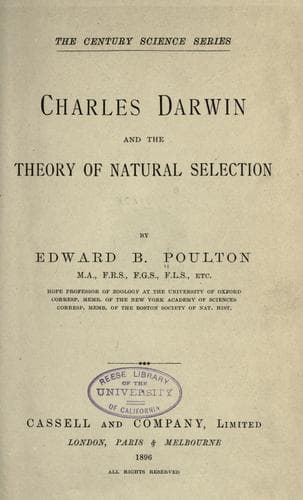
Charles Darwin and the Theory of Natural Selection — John Shaqi
Charles Darwin and the Theory of Natural SelectionPoulton, Edward Bagnall, Sir
Science
Charles Darwin and the Theory of Natural Selection
Poulton, Edward Bagnall, Sir
Darwin, Charles, 1809-1882; Natural selection
In the origin of new species by natural selection, the stress
of competition determines the survival of favourable individual
variations, and these, when by the continued operation of the
process they have become constant, are added to those pre-existing
characters of the species which are inherited from a remote past,
and are witnesses of the operation of natural selection from age to
age under ever-changing conditions of competition and variation. It
follows, therefore, that the origin of a species can only take place
once; for it is infinitely improbable that the same variation would
be independently submitted under the same conditions of competition,
and added to the mass of inherited characters independently gained in
two distinct lines by natural selection acting in the same manner upon
the same variations in the same order through all ages. Not only is it
inconceivable that the same species could arise by natural selection
from distinct lines of ancestry, but it is extremely improbable that
the same species could arise independently in more than one centre
among the individuals of a changing species; for in this case, too,
it is most unlikely that the same conditions of competition would
co-exist with the same favourable variations in the areas inhabited by
independent colonies of the same species.
[Sidenote: EARLY CRITICISM.]
Under other theories of evolution--direct action of environment,
supposed inherited effects of use and disuse, etc.--an independent
origin, even from quite distinct lines, would be probable; and we find,
accordingly, that those who would advance such theories believe in what
is called the “polyphyletic” origin of species (_e.g._ the horse), and
in the principle of “convergence” carried far enough to produce the
same complex character (_e.g._ vertebrate teeth) twice over without any
genetic connection between the forms in which the character appears.
Under natural selection, however, such a result would be infinitely
improbable, and hence this theory strongly supports, and indeed
explains, the theory of “specific centres,” viz. that each species
has arisen in one area only, and has spread from that into the other
areas over which it now occurs. This view was strongly held by Lyell
and Hooker after an exhaustive study of the facts then known as to the
geographical distribution of plants and animals; and yet both of these
distinguished naturalists seem to have feared that Darwin, in advancing
a theory which was entirely consistent with their convictions and
utterly inconsistent with any other views upon the same subject, was in
some way undermining the conclusions at which they had arrived.
Thus Lyell wrote (July 25th, 1856) to Hooker:--
Public-domain text, read in full here on John Shaqi.
Reviews
Reviews
No reviews yet
Be the first to share your thoughts on this work.
Join the Discussion
Join the discussion
Sign in to leave a comment or review.
Sign InorCreate an account