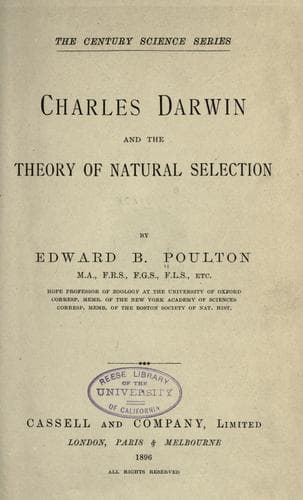
Charles Darwin and the Theory of Natural SelectionPoulton, Edward Bagnall, Sir
Science
Charles Darwin and the Theory of Natural Selection
Poulton, Edward Bagnall, Sir
Darwin, Charles, 1809-1882; Natural selection
“I fear much that if Darwin argues that species are phantoms,
he will also have to admit that single centres of dispersion
are phantoms also, and that would deprive me of much of the
value which I ascribe to the present provinces of animals and
plants, as illustrating modern and tertiary changes in physical
geography.”
And on August 5th of the same year Darwin replied to Hooker, who had
apparently argued that the origin of species by direct action of
climate, etc., would mean independent and multiple specific centres:--
“I see from your remarks that you do not understand my notions
(whether or no worth anything) about modification; I attribute
very little to the direct action of climate, etc. I suppose, in
regard to specific centres, we are at cross purposes; I should
call the kitchen garden in which the red cabbage was produced,
or the farm in which Bakewell made the Shorthorn cattle,
the specific centre of these _species_! And surely this is
centralisation enough!”
As I have argued above, Darwin was all the time affording the strongest
support to the theory of specific centres: support which was entirely
wanting in the theory of separate creation, in which the origin of each
species is wrapped in mystery, so that we can form no opinion as to
whether it took place at one centre or at many.
At this time, when the views set forth in the “Origin” were gaining
shape and expression, we cannot estimate too highly the value of the
correspondence with Hooker. In after years, when the “Origin” had to
stand the fire of adverse criticism, and at first of very general
disapproval, it was of inestimable advantage that every idea contained
in it should have been minutely discussed beforehand with one who
was more critical and more learned than the greatest of those who
afterwards objected. Darwin tells us in his “Autobiography”:--
“I think that I can say with truth that in after years, though I
cared in the highest degree for the approbation of such men as
Lyell and Hooker, who were my friends, I did not care much about
the general public.”
But, although Darwin cared nothing for it, it is nevertheless true that
the approbation of minds such as these was a sure indication of the
general approbation of the intellect of the country, and of the world,
which was to follow as soon as the new ideas were absorbed.
[Sidenote: VALUE OF THE DISCUSSION.]
And the value which Darwin himself placed on these discussions appears
again and again in his letters. To take a single example, he writes to
Hooker November 23rd, 1856:--
“I fear I shall weary you with letters, but do not answer this,
for in truth and without flattery, I so value your letters,
that after a heavy batch, as of late, I feel that I have been
extravagant and have drawn too much money, and shall therefore
have to stint myself on another occasion.”
Public-domain text, read in full here on John Shaqi.
Reviews
Reviews
No reviews yet
Be the first to share your thoughts on this work.
Join the Discussion
Join the discussion
Sign in to leave a comment or review.
Sign InorCreate an account