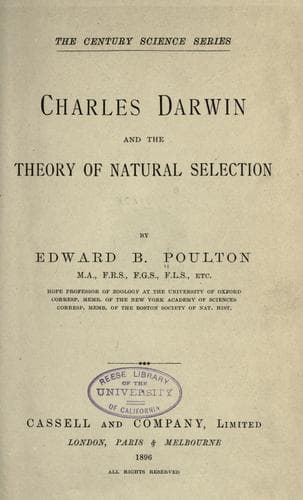
Charles Darwin and the Theory of Natural SelectionPoulton, Edward Bagnall, Sir
Science
Charles Darwin and the Theory of Natural Selection
Poulton, Edward Bagnall, Sir
Darwin, Charles, 1809-1882; Natural selection
I. The success with which selection has been applied by man in
making his breeds of domestic animals and plants: and this even
in ancient times when the selection was unconscious, viz. when
breeding was not thought of, but the most useful animals and
plants were kept and the others destroyed. “Selection acts only
by the accumulation of very slight or greater variations,” and
man in thus accumulating “_may be said_ to make the wool of one
sheep good for carpets, and another for cloth, &c.”
II. Slight variations of all parts of the organism occur in
nature, and if a being could select with reference to the whole
structure, what changes might he not effect in the almost
unlimited time of which geology assures us.
III. Animals increase so fast that, but for extermination,
the earth would not hold the progeny of even the slowest
breeding animal. Only a few in each generation can live; hence
the struggle for life, which has never yet been sufficiently
appreciated. “What a trifling difference must often determine
which shall survive and which perish!” Thus is supplied the
“unerring power” of “_Natural Selection_ ... which selects
exclusively for the good of each organic being.”
IV. If a country were changing the altered conditions would tend
to cause variation, “not but what I believe most beings vary at
all times enough for selection to act on.” Extermination would
expose the remainder to “the mutual action of a different set of
inhabitants, which I believe to be more important to the life
of each being than mere climate.” In the infinite complexity
of the struggle for life “I cannot doubt that during millions
of generations individuals of a species will be born with
some slight variation profitable to some part of its economy;
such will have a better chance of surviving and propagating
this variation, which again will be slowly increased by the
accumulative action of natural selection; and the variety
thus formed will either coexist with, or more commonly will
exterminate its parent form.” Thus complex adaptations like those
of woodpecker or mistletoe may be produced.
V. Numerous difficulties can be answered satisfactorily in time.
The supposed changes are only very gradual, and very slow, “only
a few undergoing change at any one time.” The imperfection of
the geological record accounts for deficient direct evidence of
change.
Public-domain text, read in full here on John Shaqi.
Reviews
Reviews
No reviews yet
Be the first to share your thoughts on this work.
Join the Discussion
Join the discussion
Sign in to leave a comment or review.
Sign InorCreate an account