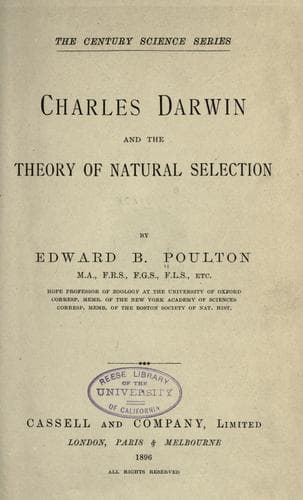
Charles Darwin and the Theory of Natural SelectionPoulton, Edward Bagnall, Sir
Science
Charles Darwin and the Theory of Natural Selection
Poulton, Edward Bagnall, Sir
Darwin, Charles, 1809-1882; Natural selection
VI. Divergence during evolution will be an advantage. “The
same spot will support more life if occupied by very diverse
forms.” Hence during the increase of species into its
offspring--varieties, or sub-species, or true species, the latter
“will try (only few will succeed) to seize on as many and as
diverse places in the economy of nature as possible,” and so
will tend to “exterminate its less well-fitted parent.” This
explains classification, in which the organic beings “always
_seem_ to branch and sub-branch like a tree from a common trunk;
the flourishing twigs destroying the less vigorous--the dead and
lost branches rudely representing extinct genera and families.”
In a postscript he says:--
“This little abstract touches only the accumulative power of
natural selection, which I look at as by far the most important
element in the production of new forms. The laws governing the
incipient or primordial variation (unimportant except as the
groundwork for selection to act on, in which respect it is all
important), I shall discuss under several heads, but I can come,
as you may well believe, only to very partial and imperfect
conclusions.”
It is, I think, of especial interest to find Darwin at this early
period arguing in a most convincing manner for the creative power
of natural selection. The selective power becomes, by accumulation,
of such paramount importance in the process, as compared with the
variations, that, although these latter are absolutely essential, man
may be said to _make_ his domestic breeds and Nature her species. The
man who argued thus had been through and had left behind the difficulty
that, even now, is often raised--that “before anything can be selected
it must be,” and therefore that selection is of small account as
compared with variation.
CHAPTER X.
WALLACE’S SECTION OF THE JOINT MEMOIR READ BEFORE THE LINNEAN SOCIETY
JULY 1, 1858.
The communication by Alfred Russel Wallace was entitled “On the
Tendency of Varieties to depart indefinitely from the Original Type.”
An abstract of it is given below.
[Sidenote: WALLACE’S ESSAY.]
_Varieties_ produced in domesticity are more or less unstable, and
often tend to return to the parent form. This is usually thought to be
true for all varieties, and to be a strong argument for the original
and permanent distinctness of species.
On the other hand, races forming “permanent or true varieties” are
well known, and there are generally no means of determining which is
the _variety_ and which the original _species_. The hypothesis of a
“permanent invariability of species” is satisfied by supposing that,
while such varieties cannot diverge from the species beyond a certain
fixed limit, they may return to it.
Public-domain text, read in full here on John Shaqi.
Reviews
Reviews
No reviews yet
Be the first to share your thoughts on this work.
Join the Discussion
Join the discussion
Sign in to leave a comment or review.
Sign InorCreate an account