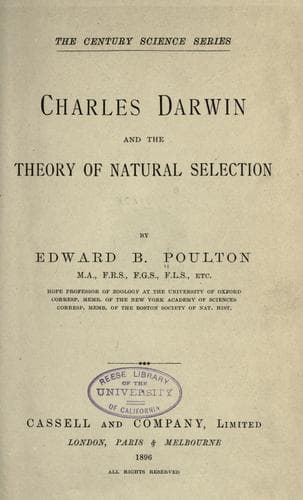
Charles Darwin and the Theory of Natural SelectionPoulton, Edward Bagnall, Sir
Science
Charles Darwin and the Theory of Natural Selection
Poulton, Edward Bagnall, Sir
Darwin, Charles, 1809-1882; Natural selection
This argument is founded on the assumption that _varieties_ in nature
are in all respects identical with those of domestic animals. The
object of the paper is to show that this is false, and “that there is
a general principle in nature which will cause many _varieties_ to
survive the parent species and to give rise to successive variations
departing further and further from the original type.” The same
principle explains the tendency of domestic animals to return to the
parent form.
“The life of wild animals is a struggle for existence.” To procure
food and escape enemies are the primary conditions of existence, and
determine abundance and rarity, frequently seen in closely allied
species.
“Large animals cannot be so abundant as small ones; the carnivora must
be less numerous than the herbivora,” eagles and lions than pigeons
and antelopes. Fecundity has little or nothing to do with this. The
least prolific animals would increase rapidly if unchecked. But wild
animals do not increase beyond their average; hence there must be an
immense amount of destruction. The abundance of species in individuals
bears no relation whatever to their fertility. Thus the excessively
abundant passenger pigeon of the United States lays only one or two
eggs. Its abundance is explained by the widespread supply of food
rendered available by its powers of flight. The food-supply “is almost
the sole condition requisite for ensuring the rapid increase of a
given species.” This explains why the sparrow is more abundant than
the red-breast, why aquatic species of birds are specially numerous
in individuals, why the wild cat is rarer than the rabbit. “So long
as a country remains physically unchanged, the numbers of its animal
population cannot materially increase.” If one species does so, others
must diminish. In the immense amount of destruction the weakest must
die, “while those that prolong their existence can only be the most
perfect in health and vigour--those who are best able to obtain food
regularly and to avoid their numerous enemies. It is, as we commenced
by remarking, ‘a struggle for existence,’ in which the weakest and
least perfectly organised must always succumb.”
This tendency must apply to species as well as individuals, the best
adapted becoming abundant, the others scarce or even extinct. If we
knew the whole of the conditions and powers of a species “we might be
able even to calculate the proportionate abundance of individuals,
which is the necessary result.”
Hence, first, _the animal population of a country is generally
stationary (due to food and other checks)_; second, _comparative
abundance or scarcity of individuals is entirely due to organisation
and resulting habits, the varying measure of success in the struggle
being balanced by a varying population in a given area_.
Public-domain text, read in full here on John Shaqi.
Reviews
Reviews
No reviews yet
Be the first to share your thoughts on this work.
Join the Discussion
Join the discussion
Sign in to leave a comment or review.
Sign InorCreate an account