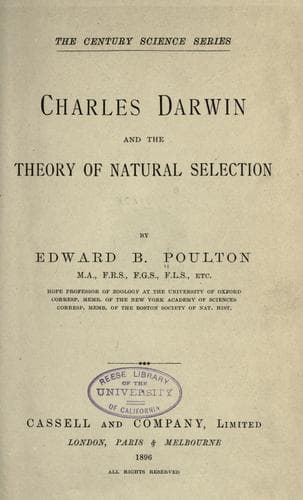
Charles Darwin and the Theory of Natural SelectionPoulton, Edward Bagnall, Sir
Science
Charles Darwin and the Theory of Natural Selection
Poulton, Edward Bagnall, Sir
Darwin, Charles, 1809-1882; Natural selection
Oliver Wendell Holmes, born in the same year, delighted to speak of the
good company in which he came into the world. On January 27th, 1894,
I had the great pleasure of sitting next to him at a dinner of the
Saturday Club in Boston, and he then spoke of the subject with the same
enthusiasm with which he deals with it in his writings; mentioning the
four distinguished names, and giving a brief epigrammatic description
of each with characteristic felicity. Dr. Holmes further said that he
remembered with much satisfaction an occasion on which he was able to
correct Darwin on a matter of scientific fact. He could not remember
the details, but we may hope for their ultimate recovery, for he said
that Darwin had written a courteous reply accepting the correction.
[Sidenote: HIS FAMILY.]
Charles Darwin’s grandfather, Erasmus Darwin (1731–1802), was a man of
great genius. He speculated upon the origin of species, and arrived at
views which were afterwards independently enunciated by Lamarck. He
resembled this great zoologist in fertility of imagination, and also in
the boldness with which he put forward suggestions, many of which were
crude and entirely untested by an appeal to facts. The poetical form in
which a part of his work was written was, doubtless, largely due to the
traditions and customs of the age in which he lived.
Robert Waring (1766–1848), the father of Charles Darwin, was the second
son of Erasmus. He married a daughter of the great Josiah Wedgwood.
Although his mother died when he was only eight years old, and Darwin
remembered very little of her, there is evidence that she directed his
attention to Nature (“Autobiography,” p. 28, footnote). Dr. Darwin
followed his father’s profession, commencing a very successful medical
practice at Shrewsbury before he was twenty-one. He was a man of great
penetration, especially in the discernment of character--a power which
was of the utmost value to him in his profession. Dr. Darwin had two
sons and four daughters: Charles was the younger son and fourth child,
his brother Erasmus being the third.
Even in this mere outline there is evidence of hereditary genius
in the Darwin family--evidence which becomes irresistible when all
available details of every member of the family are brought together,
as they are in the great “Life and Letters.” When it is further
remembered that two of Charles Darwin’s sons have achieved distinction
as scientific investigators, it will be admitted that the history of
the family affords a most striking example of hereditary intellectual
power.
Public-domain text, read in full here on John Shaqi.
Reviews
Reviews
No reviews yet
Be the first to share your thoughts on this work.
Join the Discussion
Join the discussion
Sign in to leave a comment or review.
Sign InorCreate an account