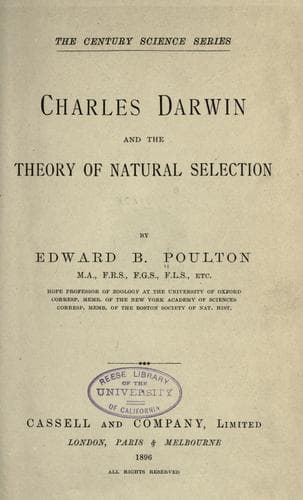
Charles Darwin and the Theory of Natural SelectionPoulton, Edward Bagnall, Sir
Science
Charles Darwin and the Theory of Natural Selection
Poulton, Edward Bagnall, Sir
Darwin, Charles, 1809-1882; Natural selection
There is nothing in this history to warrant the belief that the nature
and direction of hereditary genius receive any bias from the line of
intellectual effort pursued by a parent. We recognise the strongest
evidence for hereditary capacity, but none at all for the transmission
of results which follow the employment of capacity. Thus Erasmus
inherited high intellectual power, with a bias entirely different from
that of his younger brother Charles--his interests being literary
and artistic rather than scientific. The wide difference between the
brothers seems to have made a great impression upon Charles, for he
wrote:--
“Our minds and tastes were, however, so different, that I do not
think I owe much to him intellectually. I am inclined to agree
with Francis Galton in believing that education and environment
produce only a small effect on the mind of anyone, and that most
of our qualities are innate” (“Life and Letters,” 1887, p. 22).
Equally significant is the fact that Professor George Darwin’s
important researches in mathematics have been applied to
astronomy--subjects which were not pursued by his father.
[Sidenote: CHARACTER AND POWERS.]
It appears probable that Charles Darwin’s unique power was largely
due to the inheritance of the imagination of his grandfather combined
with the acute observation of his father. Although he possessed an
even larger share of both these qualities than his predecessors, it
is probable that he owed more to their co-operation than to the high
degree of their development.
It is a common error to suppose that the intellectual powers which
make the poet or the historian are essentially different from those
which make the man of science. Powers of observation, however acute,
could never make a scientific discoverer; for discovery requires the
creative effort of the imagination. The scientific man does not stumble
upon new facts or conclusions by accident; he finds what he looks for.
The problem before him is essentially similar to that of the historian
who tries to create an accurate and complete picture of an epoch out
of scattered records of contemporary impressions more or less true,
and none wholly true. Fertility of imagination is absolutely essential
for that step from the less to the more perfectly known which we call
discovery.
Public-domain text, read in full here on John Shaqi.
Reviews
Reviews
No reviews yet
Be the first to share your thoughts on this work.
Join the Discussion
Join the discussion
Sign in to leave a comment or review.
Sign InorCreate an account