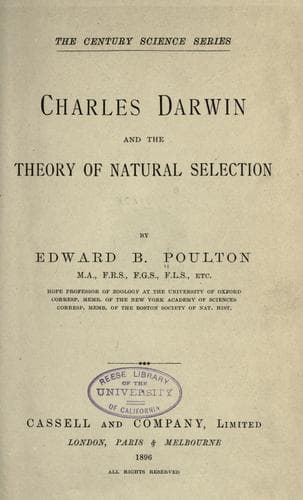
Charles Darwin and the Theory of Natural Selection — John Shaqi
Charles Darwin and the Theory of Natural SelectionPoulton, Edward Bagnall, Sir
Science
Charles Darwin and the Theory of Natural Selection
Poulton, Edward Bagnall, Sir
Darwin, Charles, 1809-1882; Natural selection
Further consideration tends to obliterate this supposed distinction.
Although Wallace used the term “variety” as contrasted with “species,”
the whole context proves that he, equally with Darwin, recognised
the importance of individual variations and of variations in single
characters. This becomes clear when we remember his argument about the
neck of the giraffe, the changes of colour and hairiness, the shorter
legs of the antelope, and the less powerful wings of the passenger
pigeon. Wallace has kindly written to me (May 12th, 1896) stating the
case as I have given it, and he further explains--
“I used the term ‘varieties’ because ‘varieties’ were alone
recognised at that time, individ^l variability being ignored or
thought of _no importance_. My ‘varieties’ therefore included
‘individual variations.’”
On the other hand, Darwin certainly included large single variations
(in other words, “varieties”) as well as ordinary individual
differences, among the material for natural selection, and he did not
abandon the former until he was convinced by the powerful reasoning of
Fleeming Jenkin (_North British Review_, June, 1867), who argued that
single large differences of a sudden and conspicuous kind (Darwin’s
“variations”) would certainly be swamped by intercrossing. Upon this
review of the “Origin” Francis Darwin says (“Life and Letters”)--
“It is not a little remarkable that the criticisms which my
father, as I believe, felt to be the most valuable ever made on
his views should have come, not from a professed naturalist but
from a Professor of Engineering.”
After reading this review, Darwin wrote to Wallace (January 22nd,
1869):--
“I always thought individual differences more important than
single variations, but now I have come to the conclusion that
they are of paramount importance, and in this I believe I agree
with you. Fleeming Jenkin’s arguments have convinced me.”
The ambiguity of this sentence evidently misled Wallace into believing
that the single variations were considered of paramount importance.
Darwin therefore wrote again (February 2nd):--
“I must have expressed myself atrociously; I meant to say exactly
the reverse of what you have understood. F. Jenkin argued in the
‘North British Review’ (June 1867) against single variations
ever being perpetuated, and has convinced me, though not in
quite so broad a manner as here put. I always thought individual
differences more important; but I was blind and thought single
variations might be preserved much oftener than I now see is
possible or probable. I mentioned this in my former note merely
because I believed that you had come to a similar conclusion,
and I like much to be in accord with you. I believe I was mainly
deceived by single variations offering such simple illustrations,
as when man selects.”
Public-domain text, read in full here on John Shaqi.
Reviews
Reviews
No reviews yet
Be the first to share your thoughts on this work.
Join the Discussion
Join the discussion
Sign in to leave a comment or review.
Sign InorCreate an account