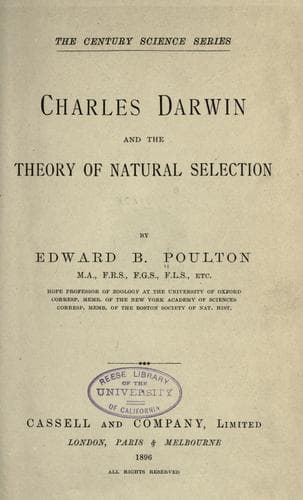
Charles Darwin and the Theory of Natural SelectionPoulton, Edward Bagnall, Sir
Science
Charles Darwin and the Theory of Natural Selection
Poulton, Edward Bagnall, Sir
Darwin, Charles, 1809-1882; Natural selection
From these two letters to Wallace we see that the latter was the first
to give up the larger variations in favour of ordinary individual
differences.
Darwin also wrote to Victor Carus on May 4th, 1869:--
“I have been led to ... infer that single variations are even of
less importance, in comparison with individual differences, than
I formerly thought.”
There has been much misconception on this point, and a theory of
evolution by the selection of large single variations--a view held by
many, but not by Darwin--has been passed off as the Darwinian theory of
natural selection. It is surprising that this old mistake should have
been repeated at so recent a date, and on so important an occasion as
the Presidential Address to the British Association at Oxford on August
8th, 1894, and that so ill-aimed a criticism should have been quoted
with approval in a leading article in the _Times_ of the following day.
The following extracts from Lord Salisbury’s address unfortunately
leave no doubt on the matter:
[Sidenote: LORD SALISBURY’S CRITICISM.]
“What is to secure that the two individuals of opposite sexes
in the primeval forest, who have been both accidentally blessed
with the same advantageous variation shall meet, and transmit by
inheritance that variation to their successors?... The biologists
do well to ask for an immeasurable expanse of time, if the
occasional meetings of advantageously varied couples from age to
age are to provide the pedigree of modifications which unite us
to our ancestor the jelly-fish.... There would be nothing but
mere chance to secure that the advantageously varied bridegroom
at one end of the wood should meet the bride, who by a happy
contingency had been advantageously varied in the same direction
at the same time at the other end of the wood. It would be a
mere chance if they ever knew of each other’s existence--a still
more unlikely chance that they should resist on both sides all
temptations to a less advantageous alliance. But unless they did
so, the new breed would never even begin, let alone the question
of its perpetuation after it had begun.”
It is of interest to reproduce Lord Salisbury’s words in close
proximity to Darwin’s real statements on the subject, as shown in the
letters to his friends--statements which are also expressed in many
places in his published works.
The joint paper was read before the Linnean Society on July 1st, 1858,
about a fortnight after Wallace’s essay had been received by Darwin.
There was no discussion, but the interest and excitement at the meeting
were very great, owing in large part to the influential support
with which the new theory came before the scientific world. Darwin
appreciated the importance of this support at its true value, for he
wrote to Hooker, July 5th:--
Public-domain text, read in full here on John Shaqi.
Reviews
Reviews
No reviews yet
Be the first to share your thoughts on this work.
Join the Discussion
Join the discussion
Sign in to leave a comment or review.
Sign InorCreate an account