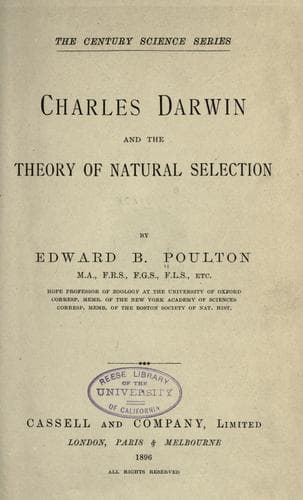
Charles Darwin and the Theory of Natural SelectionPoulton, Edward Bagnall, Sir
Science
Charles Darwin and the Theory of Natural Selection
Poulton, Edward Bagnall, Sir
Darwin, Charles, 1809-1882; Natural selection
“Many of the peculiarities which attach to biological
classifications would thus receive a reasonable explanation; but
where verification is, _ex hypothesi_, impossible, such a theory
cannot be held to be advanced out of the region of probability.
The acceptance or rejection of the general theory will depend, as
does the acceptance or rejection of other views supported merely
by probable evidence, upon the particular constitution of each
individual mind to which it is presented!”
It was too much to expect that many of the older scientific men would
retain sufficient intellectual flexibility to be able to recognise, as
Lyell had, that the facts of nature were explained and predicted better
by the new views than by those in which they had grown up. Darwin
thoroughly understood this, and, writing to his friends, maintained
that the fate of his views was in the hands of the younger men.
A grand yet simple conception like that of natural selection,
explaining and connecting together innumerable facts which people had
previously explained differently, or had become accustomed to regard as
inexplicable, must always remain as a stumbling-block to the majority
of those who have reached or passed middle life before its first
appearance.
Hardly anything is more characteristic of Darwin than the tone with
which he wrote to acknowledged opponents. Thus his letters to L.
Agassiz (1868), Quatrefages (1869 or 1870), and Fabre (1880), are
models of the way in which a correspondence which would present
peculiar difficulties to most people may be conducted. In these letters
there is not the least attempt to slur over or minimise the points of
wide difference; on the contrary, they are most candidly stated, but
with so much respect and sympathy, and with such marked appreciation
of the knowledge he had gained from his correspondent, that the reader
must have regretted the divergence of opinion as greatly as the writer.
Tyndall has given a very interesting and pathetic account of the
evident distress with which Professor L. Agassiz, chief of the
opponents of Darwin in America, recognised the success of the
teachings he could not accept.
Public-domain text, read in full here on John Shaqi.
Reviews
Reviews
No reviews yet
Be the first to share your thoughts on this work.
Elsewhere in the archive
Join the Discussion
Join the discussion
Sign in to leave a comment or review.
Sign InorCreate an account