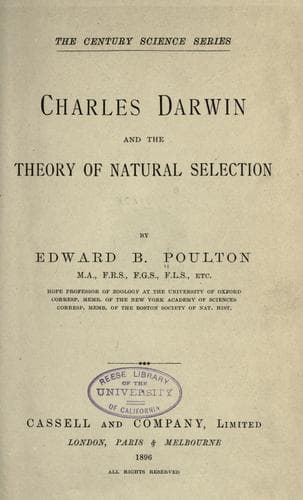
Charles Darwin and the Theory of Natural SelectionPoulton, Edward Bagnall, Sir
Science
Charles Darwin and the Theory of Natural Selection
Poulton, Edward Bagnall, Sir
Darwin, Charles, 1809-1882; Natural selection
_The functional independence of the elements or units of the body.
Variability and inheritance._--Variability generally results “from
changed conditions acting during successive generations.” The influence
is exerted on the sexual system, and if extreme, impotence tends to be
produced. Bud-variation proves that “variability is not necessarily
connected with the sexual system.” The inherited effects of use and
disuse of parts imply that the changes in the cells of a distant part
of the body affect the reproductive cells, so that the being produced
from one of these cells inherits the changes. “Nothing in the whole
circuit of physiology is more wonderful.”
“Inheritance is the rule and non-inheritance the anomaly.” Inheritance
follows laws, such as the tendency for a character to appear at
corresponding ages in parent and offspring. Reversion “proves to us
that the transmission of a character and its development ... are
distinct powers.” Crossing strongly induces reversion. “Every character
which occasionally reappears is present in a latent form in each
generation.”
* * * * *
[Sidenote: PANGENESIS.]
The hypothesis of pangenesis attempts to explain and connect together
all the facts and conclusions which have been summarised in the
preceding pages. This hypothesis assumes that each one of the
countless cells of which the body of a higher animal is composed throws
off a minute gemmule which, with those derived from other cells, exists
in the body, and when supplied with nutriment multiplies by division.
Each gemmule is capable of ultimate development into a cell similar
to the one from which it, either directly or indirectly, arose. Each
cell of the body dispatches its representative, as it were, to each
single germ-cell, and this explains how it is that the latter possess
the power of reproducing the likeness of the parent body. But the
germ-cells also receive dormant gemmules which may remain undeveloped
until some generation in the remote future. The development of the
gemmules into cells depends on their union with the developing cells
which precede them in the order of growth. Gemmules are thrown off
during each stage of growth and during maturity.
This hypothesis of pangenesis is so called because the whole body is
supposed to produce the elements from which new individuals arise, the
germ-cells being only the union of these elements into clusters.
The fact that hybrids may be produced by grafting, that the pollen can
act on the tissues of the female plant, and the male germ-cells on the
future offspring of the female, implies that the reproductive material
can exist and the reproductive processes take place in the tissues, and
that they are not confined to the germ-cells.
Public-domain text, read in full here on John Shaqi.
Reviews
Reviews
No reviews yet
Be the first to share your thoughts on this work.
Elsewhere in the archive
Join the Discussion
Join the discussion
Sign in to leave a comment or review.
Sign InorCreate an account