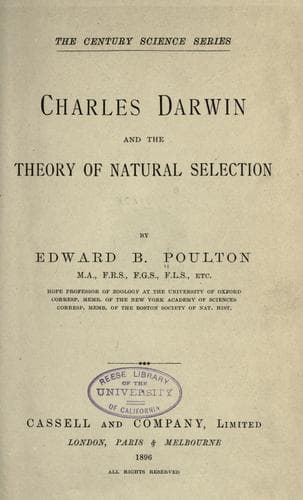
Charles Darwin and the Theory of Natural SelectionPoulton, Edward Bagnall, Sir
Science
Charles Darwin and the Theory of Natural Selection
Poulton, Edward Bagnall, Sir
Darwin, Charles, 1809-1882; Natural selection
The retention of dormant gemmules, and their passage from generation
to generation until their development, may seem improbable; but is it
more so than the _fact_ which their presence would explain--viz. the
transmission of latent structures and their ultimate reappearance?
The development of the whole plant from a Begonia leaf implies that
these gemmules are very widely distributed through the tissues.
The elective affinity of the gemmules for the cells which precede them
in growth may be paralleled by the affinity of the male and female
germ-cells, as we see in the preference of a plant for the pollen
grains of its own over those of closely-allied species, or by the
attraction of the minute germs of disease to certain tissues of the
body.
It is possible that the numerous gemmules thrown off by the cells of
a complex structure, such as a feather, “may be aggregated into a
compound gemmule.” In the case of a petal, however, where parts as well
as the whole are apt to develop, as is seen in the case of “stripes of
the calyx assuming the colour and texture of the corolla,” it is more
probable that the gemmules are separate and free. The cell itself is a
complex structure, and we do not know whether its separate parts are
not developed from the separate gemmules of an aggregate.
Such an hypothesis explains the fundamental similarity which has
already been shown to exist between all modes of reproduction. The
gemmules collected in bud or germ-cell are essentially similar;
and were it not for the special advantages of sexual reproduction
(increased vigour and more marked variation of offspring), we can well
believe that it would have been much less general. The formation of
graft-hybrids, and the action of the male element on the mother and on
future offspring, become intelligible. The antagonism between growth
and sexual reproduction in animals, and between increase by buds, etc.,
and seeds in plants, can be understood by the use of gemmules in one
direction preventing their simultaneous use in another.
Public-domain text, read in full here on John Shaqi.
Reviews
Reviews
No reviews yet
Be the first to share your thoughts on this work.
Elsewhere in the archive
Join the Discussion
Join the discussion
Sign in to leave a comment or review.
Sign InorCreate an account