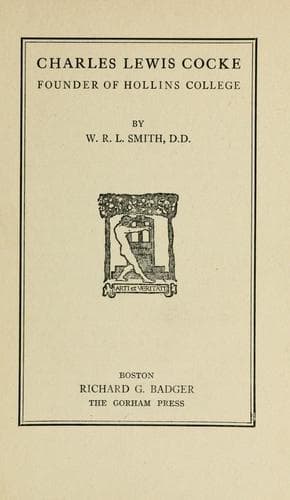
Charles Lewis Cocke, Founder of Hollins College — John Shaqi
Charles Lewis Cocke, Founder of Hollins CollegeSmith, William Robert Lee
History
Charles Lewis Cocke, Founder of Hollins College
Smith, William Robert Lee
Cocke, Charles Lewis, 1820-1901; Hollins College
In 1862, he speaks to his girls and the public in this fashion: "The
organization of this school is unlike all others in Virginia. To some
extent it is denominational, but decidedly anti-sectarian. Its Trustees
perpetuate their own existence. Its funds cannot revert to any other
object. It is responsible to no religious body and its success depends
solely on its merits. It looks to permanent existence and to the good of
the whole commonwealth. Its successes have exceeded the most sanguine
expectations of its friends. It was first to adopt a high standard of
classical education for young women in Virginia; first to place the
English Department under a regular professor; and first in the nation to
adopt the elective system of studies. With the prestige of a history of
twenty years, it may properly and confidently appeal to the general
public to make it an addition to the permanent wealth and moral
elevation of the country. I believe its reputation will spread until it
draws pupils from all over the South." Under the distressful conditions,
is there not something morally grand in this utterance? It was a
prophetic speech, and the daring prediction was more than realized in
the thirty years that followed.
In 1863, one hundred girls filled every room, and seventy-five
applicants were turned away. Oh, for the forty-six student-rooms in that
unfinished hulk! Sequestered snugly in the mountains, no Institution in
the country suffered less from the demoralization of the war. Families
driven from the areas of invasion sent their daughters to the haven of
its seclusion. The faculty of four gentlemen and three ladies had ample
occupation. It was at this juncture that the President dropped the wise
remark that the success of an Institution demands a capable manager as
much as qualified instructors, and that he is harder to find. Of course,
during this period, the depreciated currency and the correspondingly
high cost of living required advance in the rates of the tuition and
board. In 1864, one hundred and twenty-eight students were crowded into
the rooms, and an equal number were turned away. In these days of
inevitable stringency, the fare was far from luxurious, but it was
accepted by teacher and pupil with that cheerfulness which becomes
sensible and considerate people.
Public-domain text, read in full here on John Shaqi.
Reviews
Reviews
No reviews yet
Be the first to share your thoughts on this work.
Join the Discussion
Join the discussion
Sign in to leave a comment or review.
Sign InorCreate an account