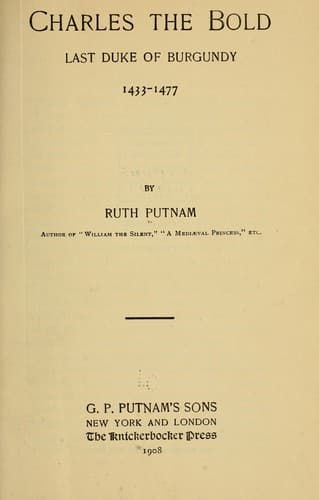
Charles the Bold, Last Duke of Burgundy, 1433-1477Putnam, Ruth
History
Charles the Bold, Last Duke of Burgundy, 1433-1477
Putnam, Ruth
Burgundy (France) -- History; Charles, Duke of Burgundy, 1433-1477; Switzerland -- History -- 1032-1499
La Marche[23] records one return of Philip to Brussels when his
arrival was greeted by Charles of Burgundy, honourably accompanied
by children of high birth about his age or less, some only eleven or
twelve years old. There were with him Jehan de la Trémoille, Philip
de Croy, Philip de Crèvecoeur, Philip de Wavrin, and many others. All
were mounted on little horses harnessed like that of their governor, a
very honest and wise gentleman, named Messire Jehan, Seigneur et Ber
d'Auxy. This gentleman was a fine man, well known, of good lineage,
ready of speech and able to discuss matters of honour and of state.
He was both hunter and falconer, skilled in all exercise and sport.
"Never [asserts La Marche] have I met a gentleman better adapted
to supervise the education of a young prince than he.... Among his
pupils were also Anthony, Bastard of Burgundy,[24] son of Philip,
and the Marquis Hugues de Rottelin. These lads were older than the
first mentioned."
La Marche dilates on the pleasure the duke felt in this youthful band
of horse, and then tells how, within Brussels,
"he was received by the magistrates and conducted to his palace,
where the Duchess of Burgundy awaited him holding by the hand
Madame Catherine of France, Countess of Charolais. She was about
twelve and seemed a lady grown, for she was good and wise, and
well conditioned for her age."
At various state functions the Count and Countess of Charolais
appeared together in public, and witnessed certain of the gorgeous
and costly entertainments which were almost the daily food of the gay
Burgundian court. One of these occasions was calculated to make a deep
impression on the boy and to arouse his pride at the spectacle of a
proud city wooing his father's favour, in deep humiliation.
In 1436, an insurrection had occurred in Bruges, when the animosity of
the burghers had caused the duchess to flee from their midst, holding
her little son in her arms, alarmed for his personal safety. Philip
suppressed the revolt, but, in his anger at its insolence, declared
that never again would he set foot within the gates unless in company
with his superior.
[Illustration: PHILIP THE GOOD AS PATRON OF LETTERS
THE YOUNG COUNT OF CHAROLAIS IS IN THE BACKGROUND WITH ONE OF PHILIP'S
SONS FROM MINIATURE REPRODUCED IN BARANTE, "HIST. DES DUCS DE
BOURGOGNE"]
Among the many negotiations wherein Isabella played a prominent part
as her husband's representative, were those concerning the liberation
of the Duke of Orleans, who had remained in England, a prisoner, after
the battle of Agincourt in 1415. The last advice given by Henry V.
to his brothers was that they should make this captivity perpetual.
Therefore, whenever overtures were made for his redemption, a strong
party, headed by Humphrey of Gloucester, rejected them vehemently.
Public-domain text, read in full here on John Shaqi.
Reviews
Reviews
No reviews yet
Be the first to share your thoughts on this work.
Join the Discussion
Join the discussion
Sign in to leave a comment or review.
Sign InorCreate an account