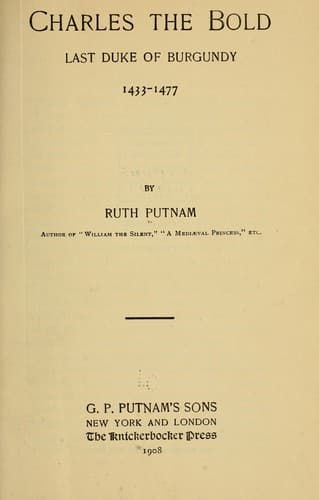
Charles the Bold, Last Duke of Burgundy, 1433-1477Putnam, Ruth
History
Charles the Bold, Last Duke of Burgundy, 1433-1477
Putnam, Ruth
Burgundy (France) -- History; Charles, Duke of Burgundy, 1433-1477; Switzerland -- History -- 1032-1499
In 1440, however, there was a turn in the tide of sentiment. Possibly
the low state of the English exchequer made the duke's ransom more
attractive than his person. At any rate, 120,000 golden crowns were
accepted as his equivalent, and the exile of twenty-five years
returned to France, having pledged himself never to bear arms against
England.
Isabella of Burgundy was at Calais to welcome him, and to escort him
to St. Omer, where high revels were held in his honour and in that of
his alliance with Marie of Cleves, Philip's niece.
The week intervening between the betrothal and the nuptials was
passed in a succession of banquets and tourneys, gorgeous in their
elaboration. Moreover, St. Andrew's Day chancing to fall just then,
the new Burgundian Order was convened and the Duke of Orleans was
elected a Knight of the Golden Fleece, while in his turn he presented
his cousin with the collar of his own Order of the Porcupine. Lord
Cornwallis and other English gentlemen who had accompanied Orleans
across the Channel participated in these gaieties, nor were they among
the least favoured guests, adds Barante.
Amity was triumphant, and there was a general feeling abroad that the
returned exile was henceforth to be the ruling power in France. People
began to look to him to act as the go-between in their behalf, to be
their mediator with Charles VII., still little known at his best. Many
towns turned towards him in hopes of finding a friend, and among them
was Bruges. But it was not royal favours that Bruges sought. Her
burghers felt great inconvenience from the breach with their sovereign
duke. Anxious to be reinstated in his grace, they seized the
opportunity of reminding Philip of his assertion, and they besought
him to enter their gates in company with the Duke of Orleans, a
prince of the blood, closer to the French sovereign than the Duke of
Burgundy.
After some demur, Philip consented to grant their petition. Possibly
he was not loth to be persuaded. The deputies hastened back to Bruges
to rejoice their fellow-citizens with the news, and to prepare a
reception for their appeased sovereign, calculated to make him content
with the late rebels.
Before the grand cortège, composed of the two dukes, their consorts,
and the dignitaries who had assisted in the feasts of marriage and of
chivalry, reached the gates of Bruges, the citizens were ready with a
touching spectacle of humility and repentance.[25]
Public-domain text, read in full here on John Shaqi.
Reviews
Reviews
No reviews yet
Be the first to share your thoughts on this work.
Join the Discussion
Join the discussion
Sign in to leave a comment or review.
Sign InorCreate an account